

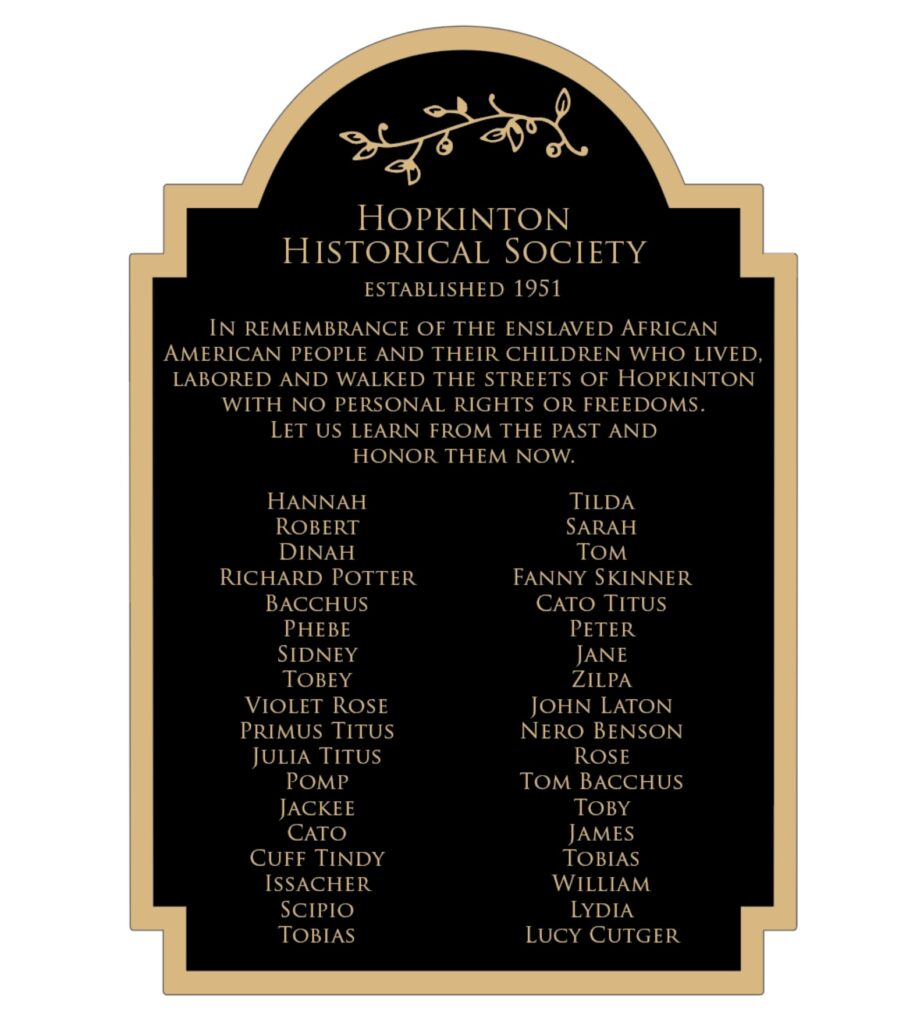
The Historical Society shared this design for a plaque to honor enslaved residents.
The Select Board on Tuesday reviewed a request by the Hopkinton Historical Society to commemorate the history and contributions of people enslaved in Hopkinton with a plaque on the Town Common. It stirred discussions about accuracy, the request for Select Board input and the criteria by which memorial requests are reviewed.
While the request originated with the Hopkinton Historical Society, the Parks & Recreation Commission has purview over what memorials will be placed on land under its jurisdiction. Society members appeared before the commission last September as well as in March. The Parks & Recreation Commission sought input from the Select Board because of the sensitive nature of this period in the town’s history.
The proposed bronze plaque would feature the names of 36 enslaved persons identified as living in Hopkinton between the town’s founding in 1715 to around 1790, when the last enslaved person was listed on the town census. The current design of the bronze plaque measures 14 inches wide and 20.5 inches high.
At the March Parks & Recreation Commission meeting, chair Dan Terry said the context about slavery in town should be included as well as the names of the enslaved to make it more educational. He also sought “a broader discussion” in town before the commission rendered its decision.
Peer review process raises questions on research
“The purpose of the Historical Society’s project is to honor people … whose names and personal histories were unknown, who were in a sense invisible, as they were viewed as property rather than citizens and were bound in servitude in Hopkinton during their lives,” explained Town Manager Elaine Lazarus.
She added that when the Select Board received the request from the Parks & Recreation Commission, a peer review process was initiated. She noted that this was a “challenge” because the enslaved people did not own property, pay taxes or write wills that would have documented their existence.
Said Lazarus: “They may only appear in documents pertaining to the people who own them.”
The peer review found issues with some of the research. For example, each enslaved person’s name must have evidence of having been owned by a real person as well as being enslaved in Hopkinton at some point.
The review concluded that more research needed to be done. It recommended that a professional genealogist who specializes in researching enslaved people be hired. Also, Lazarus said it suggested “separating the physical memorial from the cataloging of names” so that names can be added or removed and stories about the enslaved people can be referenced.
Decade of research defended
Hopkinton Historical Society archivist Linda Connelly took issue with the statement about her research. She has dedicated 10 years to her work.
“I have to say that when I shared my notes on the research, that was by no means a finished copy,” she explained. “I didn’t know that it was going to be sent for peer review.”
She added that she did “really tight research,” attributing 17 sources in the bibliography.
Anne Mattina, the society’s president, said Connelly came up with the idea for a memorial plaque after experiencing the reading of a famous speech by formerly enslaved orator Frederick Douglass on the Town Common last May. It is entitled “What to the Slave is the Fourth of July?”
She confirmed that neither she nor Connelly knew that Connelly’s notes to the Town Manager’s office were going out to be peer reviewed. Mattina said Connelly has since “polished up” the document.
“It seems to us a little overreach that we have to prove, even more so, that [the enslaved people] lived here,” Mattina added.
Stressed Mattina: “You’re not going to get on ancestry.com and find them.”
Added Connelly: “It’s been 300 years. Could we do something just to acknowledge them and to broaden the history?”
Mattina said the society had “no problem” putting a page on its website documenting and updating the enslaved people’s names and stories. She also suggested that a QR code be placed on the memorial itself to direct people to explore this information. But both Mattina and Connelly were adamant that the names that have been confirmed now be on the memorial.
Question raised on need for Select Board input
Member Matthew Kizner asked representatives from the Parks & Recreation Commission to come before the board to hear their concerns. He described the commission as putting “a hold on the decision in lieu of making it.”
Chair Joe Clark tried to intervene. Kizner said he wanted to hear the explanation rather than just the “churn around the historical accuracy” of the work. With no objections from other members, Clark called Terry forward.
Terry explained that he sought Select Board input because “it was heavier than just a plaque on the common.” He said he sent the request to the Select Board in April.
Because there has never been a plaque request before, there are no criteria in place to determine request approval, he added in answer to a question by Kizner.
“I just hope that we can be better aligned in the future,” vice chair Shahidul Mannan said of the apparent rift between the commission and the society on the project.
Member Amy Ritterbusch noted that there has historically been tension between the two entities. She and the other members were supportive of the memorial plaque’s installation on the Town Common.
“We have a memorial to our founding white families that were not enslaved on the common,” she said. “So, I think having a memorial to these people is appropriate on the common as well.”
Kizner suggested that the two groups work together so that Select Board guidance would not be sought again.
Member Brian Herr disagreed, saying that he didn’t believe “our colleagues in local government” should be dissuaded from seeking input and advice from the Select Board. He also suggested wording that would include commemorating the lives of the enslaved people who could not be identified.














Just to clarify, we know have 42 names two people who served in The American Revolution.
Oops, make that 41 names. Additionally I edited my notes and details relating to the enslaved people in order to prove accuracy, the bibliography was expanded, but I don’t think the newer information was submitted for a second peer review.
Linda Connelly
Hopkinton Historical Society
This statement sums up very well how most of us feel. “We have a memorial to our founding white families that were not enslaved on the common,” she said. “So, I think having a memorial to these people is appropriate on the common as well.”
And this sums up those who are dragging their feet by coming up with excuses and obstacles. Terry explained that he sought Select Board input because “it was heavier than just a plaque on the common.” What??!
Just put it up already!
It pleases me to see the passion for history and accuracy in this perfectly executed example of democratic process. Thanks to our historians and town leadership for taking the time to do this right.