

On Thursday, the School Committee gave administrators direction on how to proceed with HVAC projects at the middle and high schools.
Assistant Superintendent for Finance and Operations Susan Rothermich gave a presentation on how to accomplish these projects without putting more debt and tax burden on the community.
“We’re trying to time [this] out to have little or no impact,” Rothermich said.
At the high school, the budget cost for the geothermal water to water heat pump (WWHP) system totals $18.9 million. MassSave and Federal Tax Credits are $1.3 million and $6.4 million, respectively.
Rothermich said the WWHP option is most favorable, with baseline energy savings of $6,500 and cooling adjustment energy savings of $86,000. The savings on geothermal is more than what would be achieved replacing in kind what currently exists and adding cooling.
The net cost comparisons would be $11.2 million for geothermal and $11.5 million for traditional plus cooling.
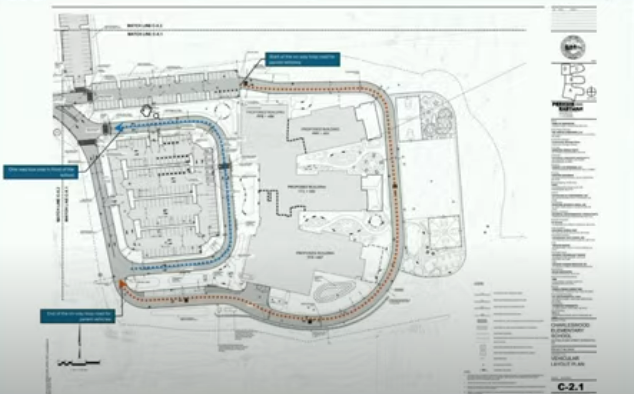
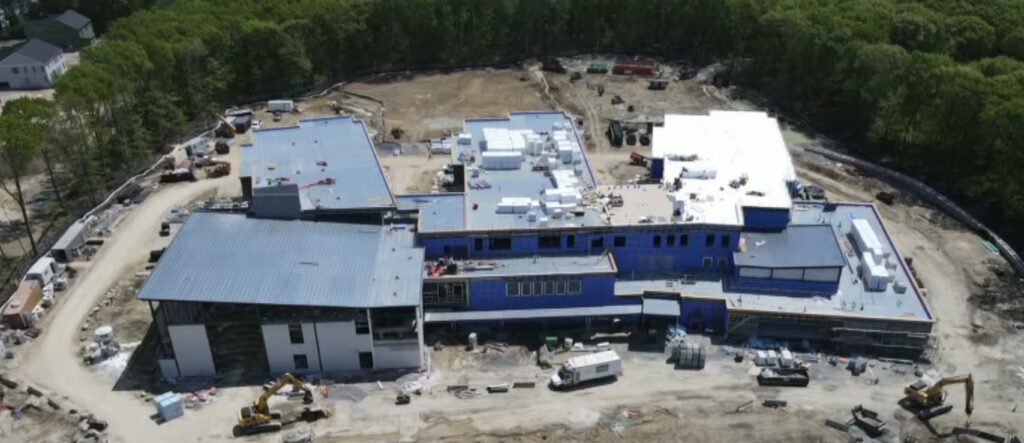
Rothermich spoke about the debt for the Charleswood School project, noting the construction contract is $22,684,689 under budget and contingency is $9,472,944 under budget, for a total of $38 million under budget.
Rothermich emphasized, “However, the project is early on and there will be change orders; $38 million will not be the number, but it gives you an idea of the magnitude where we stand [now].”
She outlined how the district is “conservatively estimating” the Charleswood project as coming in under budget by $20 million.
Combining that with Mass Save credits on the Hopkins School project expected in the fall of 2026 ($513,000), subsequent credits given in fiscal year 2027 ($1.8 million), and the same for Charleswood in FY 28 ($1.9 million), it means the district would be able to cover the high school HVAC project, she said.
A potential scenario would include seeking a Town Meeting vote in May of 2027 to add the HVAC high school project onto the 10-year plan and give engineering consultant CMTA direction on how to proceed.
After that, Rothermich highlighted how debt would work for a middle school hybrid geothermal system with a $15.3 million budget ($11.05 million net) and Mass Save credits of $3.5 million.
That project’s cost could be offset by credits for the Charleswood project in the summer of 2029, the high school WWHP project in the summer of 2029 and so on.
She said this time next year, the district would have a better idea how things are going a year into construction on Charleswood.
Member Nancy Cavanaugh clarified that debt savings from one project could not automatically be transferred to fund a different project. “It’s separate votes,” she said.
Cavanaugh added that she hoped Town Meeting would see the logic and rationale about using timing, tax credits and Charleswood’s under budget amount over several years to accomplish the HVAC work.
“Geothermal makes the most sense to meet green initiatives,” she said. “The biggest thing is timing of debt, and I like the idea of doing it in FY 28. On the flip side, how much liability is there if issues come up with the high school boilers?”
Rothermich said the high school has five boilers, so if one goes off, it does not mean the school will not be heated.
Chair Kyla McSweeney said she understands the “huge concern” by residents that their taxes will increase again. “But we also have to do something about the boilers at the high school.”
Prior to the presentation, Sustainability Green Committee chair Geoff Rowland offered his support of the geothermal water to water heat pump option at the high school and geothermal hybrid option at the middle school.
He said it was a “win-win” with strategic timing to get ahead of failing systems, achieve climate goals and financial incentives and open the possibility of Green Communities ($500,000) and Climate Leaders ($1 million) grants.
Rowland said the geothermal options align with recent decisions on energy efficiencies at the other schools and “put you on the path to reach the town’s net zero goals. … The most [financially] smart choice is also the greatest.”
FY 27 capital plan approved
After hearing a presentation on the 10-year capital plan, the School Committee focused on and approved moving forward the FY 27 capital requests. They include a handicapped accessible vehicle for the 18-22 special education program ($95,000); classroom desks and chairs at the middle school ($217,000); and technology including projectors, security upgrades, radio and camera replacements ($150,000).
Town Meeting ultimately votes on capital items.















Concern is uncertainty of Federal funding also affects State funding.