

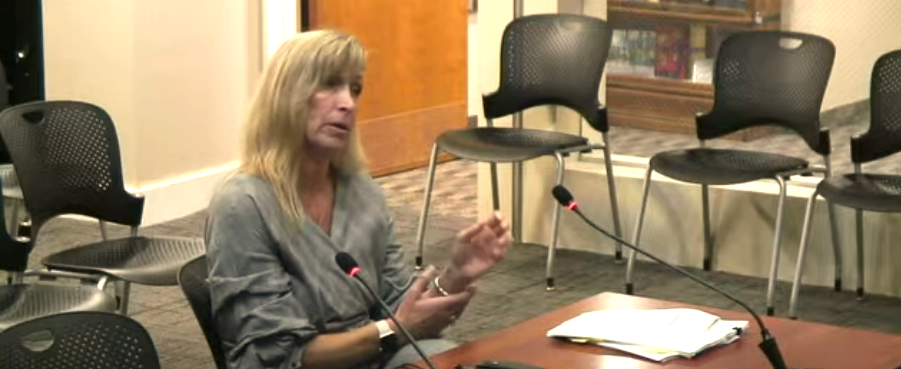
Chief Financial Officer Kyla LaPierre presented a stark picture of the town’s financial situation.
The Economic Development Advisory Board on Tuesday heard a grim depiction of Hopkinton’s finances in upcoming fiscal years from the town’s chief financial officer.
CFO Kyla LaPierre, the meeting’s guest speaker, told the board that the town’s upcoming capital projects could spur talks of an override. In 1980, the state’s property tax levy was capped at 2.5% each year under Proposition 2½. The money raised generates municipal revenue to support local spending for schools, public safety and other public services.
She sought to give members a “general sense” of the town’s financial landscape for the next couple of fiscal years.
“From a financial forecast, I think we’re going to be OK for FY 27 without additional debt,” explained LaPierre. “It’s not a good outlook over the next couple of years.”
Expenses are increasing at a rate higher than 2.5%, she said. For example, the school budget is expected to increase to $70 million, a 6% jump. She noted that this budget has been increasing by 5-6% “year after year.” But there is not much to trim because of increasing student enrollment.
The forecast for the following two fiscal years, she added, is “not as positive.” She projected a $1 million deficit for both FY 28 and FY 29 unless the town takes on additional debt.
School construction in FY 26 will amount to $14 million, according to LaPierre. Projected amounts of $4 million for FY 28 and $28 million for FY 29 are on the horizon, provided that current projects do not carry over into successive years.
“Revenue is extremely thin,” she stressed. “Everything you’re doing is exceedingly important in order to increase that revenue. Because right now, the debt’s just going to continue to increase.”
The town’s operating budget for FY 27 is estimated at $132 million, LaPierre explained. This does not include capital expenditures. Department operating budgets are due to her office by Friday.
Stressed LaPierre: “Unless we find new businesses, debt’s going to continue spiraling.”
Infrastructure needs cause strain
One issue LaPierre mentioned was that Hopkinton has grown so rapidly over the past several years that the town’s infrastructure has not kept pace with it.
For example, the School Department has an HVAC project that is estimated to cost the town $34 million over FY 27-28. While the town is expected to get reimbursed for most of it, the town has to front the money.
Other projects include $34 million for the connection to the Massachusetts Water Resources Authority, (MWRA), a $1 million upgrade for the Senior Center and water main replacement at a cost of $5 million.
A critical project LaPierre mentioned was roadwork on Grove Street. It will require an “emergency replacement” that will impact the town.
Added LaPierre: “There’s a roof replacement that’s needed, or else the fire station is going to cave in.”
Member Parker Happ questioned if some expenses are “nice-to-haves.” LaPierre mentioned that holiday lights on the Town Common and weekend hours at the library may fall into that category for some people. While they bring enjoyment to residents, they “add to the bottom line.”
“This is the reality,” said LaPierre. “We may not be able to solve it. We may have to cut services.”
Split tax rate discussed
LaPierre mentioned the possibility of creating a split tax rate.
Member Finley Perry, a former chair of the Board of Assessors and a member of the now-defunct Growth Study Committee, offered some perspective. He said this was done in the early 1990s for a couple of years during the commercial real estate recession. Later, there was pushback from commercial entities, Perry said. It has not been proposed since that time.
Perry also outlined two key issues. One is how the town feels about changing the tax ratio of the residential and commercial/industrial tax bases. The second is what Town Meeting members have control over regarding approving expenditures.
Noted Perry: “It’s going to be very difficult to move that needle one way or the other.”
Happ mentioned that Boston Mayor Michelle Wu is currently proposing asking the state Legislature to repeal or reform Proposition 2½.
LaPierre noted that several towns have proposed overrides for FY 26. But half of them failed.
While taxpayers likely will continue to face a financial burden, Perry added that there are ways to make the town “more vital and vibrant” from an economic development standpoint. This is the EDAB’s goal.
TIF ‘pros and cons’ outlined
Happ asked if tax increment financing (TIF) agreements would be beneficial.
TIFs allow new businesses to pay lower tax rates when they initially open if they provide a community benefit. The amount gradually increases as the business becomes more established.
Yevgeniy Galper is in the process of constructing Open Play Pickleball & Padel Club. The 25,000-square-foot, state-of-the-art facility at 124 East Main Street is expected to open in December. It will offer 19 indoor and outdoor courts for the fast-growing sports. The Select Board at its Oct. 7 meeting granted Town Manager Elaine Lazarus permission to enter into negotiations on a TIF with Galper.
LaPierre said TIFs “are great for the businesses coming in,” but the request comes at a time when the town is strapped financially.
On the other hand, Julia Chun, the town’s sustainability, economic development and equity project manager, said a TIF could be viable in this case. Typically TIFs can last 14 years, she explained, but they can be much shorter depending on the business.
“It is a tool to increase revenue,” she stressed. “TIF is not eradicating taxes. It’s giving them a break for a number of years.”
Chun noted that Open Play is being built on a leaching field that had not been able to be sold for a decade. This will bring in tax revenue and employees.
LaPierre added that it will likely also create jobs and internships for students in a growing field. She saw “downstream impacts” potentially being generated by the TIF in this instance.
As a self-proclaimed “newbie” in town, Happ said there was a dichotomy between traditionalists who love Hopkinton’s small-town charm and those who want to see growth.
“Charm and quaintness doesn’t pay for my tax liability,” he said. He noted that it comes down to either “pay up or grow.”
“It’s probably both,” added Happ. “But that’s what we’re kind of facing.”
“I think we’re taking in the information and trying to understand some of the pros and cons,” said chair Jordan Thayer.
Meals tax generates $200,000
Chun said the meals tax implemented in January has generated $200,000. The Hopkinton Chamber of Commerce recently recommended that the money be used to fund a full-time economic development director. Chun said a person dedicated solely to economic development would have a budget.
















Small town charm can be maintained with careful, insightful management of the growth but without growth many of those who love the small town charm won’t be able to live here due to the increasing tax burden.
Wait until the upcoming lawsuits hit the town. Insurance won’t cover the damages in full.
The town could end up in receivership.
You can thank the last and current selectboard and Chief of Police
Know that there MUST be a PUBLIC HEARING to approve any TIF. As of this time, none has been held.
My take is the proposed is not economic development. The owner asked for the TIF after his project is in full development.
The Proponents must objectively quantify the benefit to the Town and it’s citizens. I have serious doubts whether any TIF is beneficial to economic development.
In my opinion, this TIF is just a hand-out of many that the Town needs. It’s a “money grab” that will open the door to other small, private businesses looking for free money.
Commercial RE Brokers and the Chamber of Commerce should be the ones finding tenants and buyers of under utilized office, warehousing, manufacturing, research and retail buildings.