

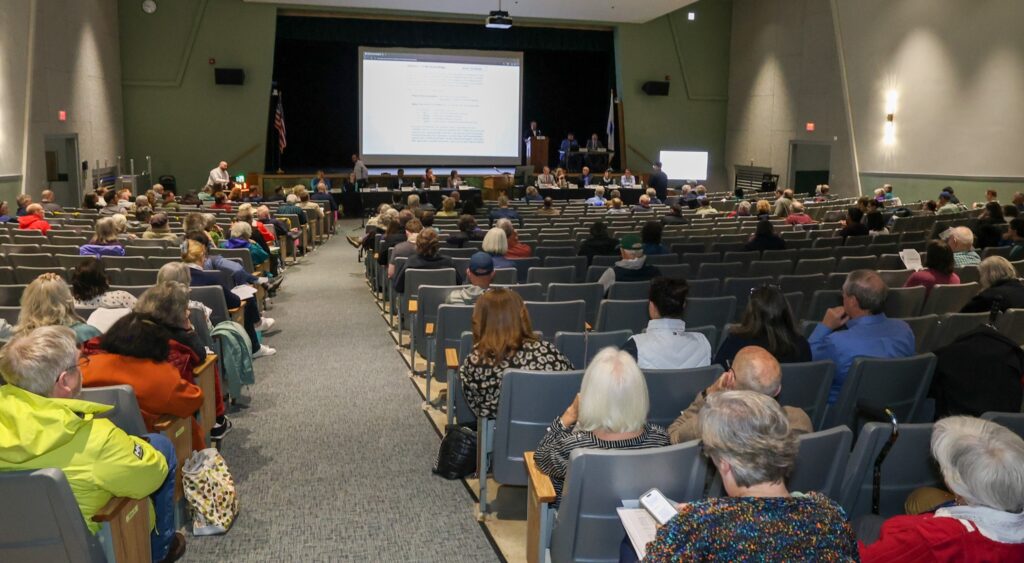
A Special Town Meeting is being convened on Thursday, Dec. 4, at 7 p.m. at the high school auditorium. The sole article calls for a vote to amend the town’s fiscal year 2026 operating budget.
An overestimate of the town’s operating expenses has led to an unexpected sum of about $5.7 million. If passed, the tax levy and tax rate will be lower on the next tax bills issued than previously estimated.
In order to do this, STM would need to vote on amending this operating budget. The urgency for an STM comes from the need to have the outcome determined before the quarterly tax bills go out at the end of December.
Budget calculations explained
Town Manager Elaine Lazarus explained the situation in greater detail in an email to the Independent.
“Every year, the town’s budget that is voted at the Annual Town Meeting in May is based on estimates and projections of revenues and expenditures,” she stated. “This is because it’s based on the best information at the time — much of this information is not known until the following summer/early fall — which is after the beginning of the fiscal year on July 1. The budget must be voted before July 1.”
In the fall, the amount is recalculated using actual expenditures from the prior fiscal year, which ended June 30. Included in these calculations are the “firmed-up revenue numbers” for the new fiscal year, the operating budgets voted at Town Meeting, along with new growth, debt and capital exclusions, and other charges. These numbers are used to set the tax rate for the new fiscal year.
Added Lazarus: “The quarterly tax bills that go out in the summer/fall are estimated, because the tax rate has not yet been set for the new fiscal year.”
“Appropriations for budgets and capital projects come from a variety of sources,” the town manager stated. “The non-taxation revenue sources include state aid, free cash, ambulance receipts, community preservation funds, enterprise funds and fees.
“What does not come from these sources must be raised,” she continued. “Revenue sources are subtracted from the total planned expenditures, and this remaining amount must be raised through the property tax levy.”
The town has a levy limit, which is the total dollar amount of taxes the local government is authorized by law to collect. The levy limit increases each year as a 2.5% annual increase, known as Proposition 2 1/2. New growth, including revenue from new construction and development, and debt exclusion/capital exclusions are factored into this amount.
“When calculating the maximum levy, the excluded debt is based on the actual number, not the estimated number that was calculated leading up to the Annual Town Meeting,” Lazarus explained.
For FY 26, the calculated levy is $93,803,493. The excluded debt for FY 26 is $8,362,350. The maximum allowable levy is calculated by adding those two figures, which totals $102,165,846.
Tax rate-setting key
The tax rate-setting process uses the actual numbers rather than estimates for the expense calculation used at May’s ATM. Lazarus stated that “[a] few key actuals” now affect the FY 26 budget:
- The health care costs were estimated based on FY 25 estimates and not the actuals that became known after July 1. There was a $2.2 million savings in health care costs in FY 25.
- The debt exclusion and debt payment was estimated based on borrowing $81 million and conservative market conditions. This estimate resulted in debt payments over $12 million. But the actual borrowing was done in a short-term note at 3%, which saved $3.5 million.
There also were a few negative financial changes. They included a snow and ice deficit of $500,000 and tax abatements/exemptions of $530,000. In addition, new growth was $400,000 less than originally projected, which reduced this estimated revenue source.
The budget voted at ATM had total expenditures originally projected to exceed $154 million. The revenue from other sources was estimated to come in at $46 million.
“The difference between the two is the amount of tax that was anticipated to be needed: $108 million,” explained Lazarus. “However, as stated above, the maximum levy calculation indicated the town is only allowed to collect $102 million, and examination of why this happened pointed to the health care and debt payment savings.”
She stressed that once those reductions are approved at STM, the amount needed to raise by taxation will be less than the levy limit of $102 million. This vote will reduce the amount of property tax that the town is authorized to collect in FY 26.
Added Lazarus: “The reduction will not affect any department’s operating budget, and no services will be affected.”
Additional information is available on the town website.















You mean that you extorted too much from the taxpayers and rather than return it, you want to stuff it into your pockets?
In my nearly 14 years as a resident, I don’t think the town has ever needed to make a correction like this and it’s my understanding that the budgets were always based on “estimates and projections.” So what happened this year? Looks like in all the “sharpening of the pencils” during the last budget cycle, someone in Finance made a significant error. The operating budget voted at May ATM was beyond the levy limit by several million dollars, and we really lucked out that the employee insurance cost came in 2.2M below the estimates. If the insurance cost came it at the estimate, then we would be scrambling to plug the gap. Hope the levy is calculated correctly for FY27!