

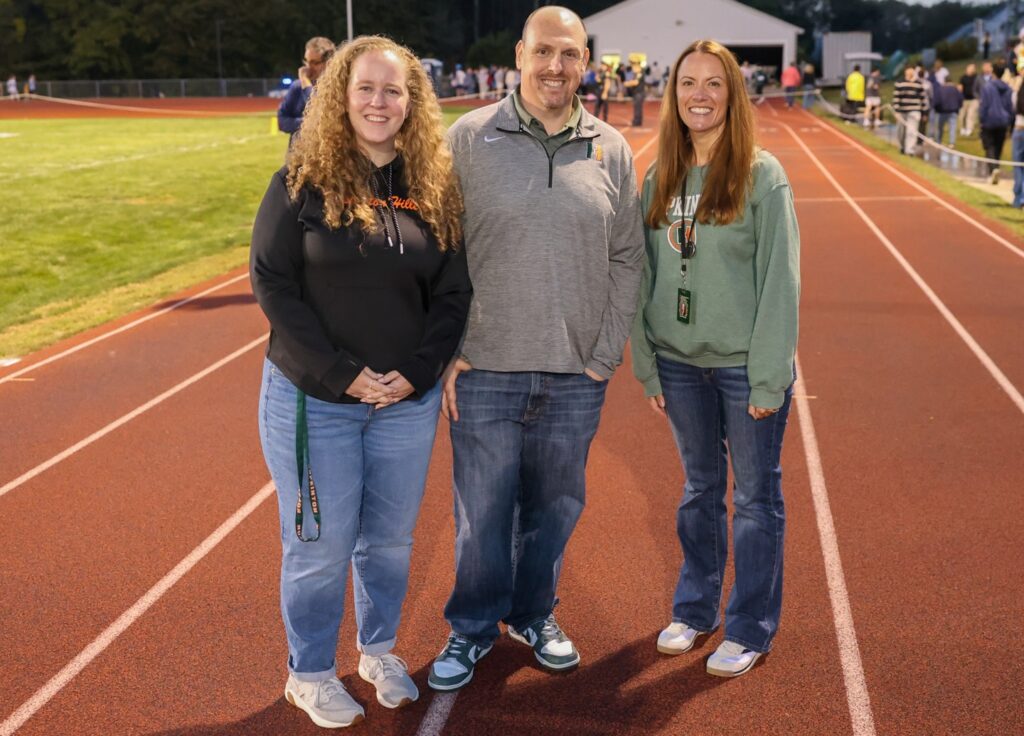
Justin Pominville (center), Hopkinton High School’s interim principal, is seeking another vice principal to complement Laura Theis (left) and Sarah Ellam (right) as the district deals with increased enrollment. PHOTO/JOHN CARDILLO
A request for an additional assistant principal at the high school sparked the most discussion at Thursday’s School Committee meeting. All building administrators highlighted fiscal year 2027 budget proposals.
Hopkinton High School
Interim Principal Justin Pominville presented a budget of approximately $12 million, an increase of 6.3%, before new requests.
Contractual increases comprise $713,322 (6.5%) for existing staff.
Also in the budget is a $125,000 request for an additional 1.0 full-time equivalent (FTE) assistant principal, bringing the number at the high school from two to three.
Pominville said another assistant principal is needed to assist with managing growing enrollment. Currently, enrollment is 1,296 in Grades 9-12, which means each assistant principal has a caseload of 649 students.
With large classes coming up from the middle school, caseloads are expected to jump to 677 and then 719 and 751 in the following school years, according to Pominville.
Another school administrator would mean additional support for students, disciplinary assistance and better communication with parents/guardians, Pominville said.
“The role of an assistant principal has changed over the past 10 years,” he noted.
He said each assistant principal is responsible for evaluative/instructional work for 40-50 staff members, must plan and implement restorative practices for students (as an alternative to suspensions), oversees bullying investigations, and has other disciplinary and non-disciplinary functions.
“[Student] behaviors are changing, and the job is becoming more difficult,” Pominville noted.
Crucially, he said, assistant principals typically build communication and trust with students and families over the years.
School Committee member Chris Masters said he prefers to see money spent on “student-facing” items. “I worry about administrative bloat,” he said.
Masters said he “pushes back” on filling positions that are anticipated as a need in the future.
He said the town is spending a lot of money on the schools, and he is looking for the district to have “financial responsibility.”
Pominville noted an assistant principal is needed now because of the high caseloads, expanded duties and a “marked” 28% increase in disciplinary referrals from last year to this one.
“Closing the loop of communication” with students and families and helping to change behaviors require time and resources, according to the interim principal.
School Committee member Jamie Wronka noted that Natick has three assistant principals with caseloads of 550 students and is seeking a dean of students.
She questioned waiting to fill the position until a problem arises such as a certain number of students do not meet competency or scores drop to a particular level.
Pominville also reviewed other aspects of the proposed budget.
The overall expense account shows a decrease of 0.1%.
He said of 34 non-payroll accounts, 21 have either been level-funded or shown a decrease as compared to the FY 26 budget. For the 13 remaining accounts, only one (general supply) has a an increase — $4,200 for three additional pallets of paper (going from six to nine) because of more writing assignments and packet creation.
The other principals gave their budget overviews as well.
Marathon School
Principal Lauren Dubeau spoke on behalf of Marathon School, noting the proposed FY 27 budget of $5.1 million is an increase of $232,171, or 4.7%.
Marathon has 14 kindergarten classrooms with class sizes ranging from 18-22 students along with 14 first grade classrooms with class sizes of 17-20 students.
She said the proposed budget includes a 5.89% increase ($213,245) for classroom teachers and a 3% increase ($13,086) for general education paraprofessionals. There are no requests for additional personnel.
Of the contractual obligations, Dubeau said, “We are fortunate we have a qualified staff who likes to stay [in the district].”
She noted the proposed general supply expense budget totals $67,427, which breaks down to $103 per student for items like paper, practice books/notebooks, folders and art supplies.
Elmwood School
Principal David Brauninger presented an Elmwood School budget that is 5.1% ($250,453) higher than the last fiscal year, with most of that amount for personnel contract obligations.
Brauninger said the proposal also has a 2% increase in the expense account for copier/equipment maintenance and does not ask for any new personnel.
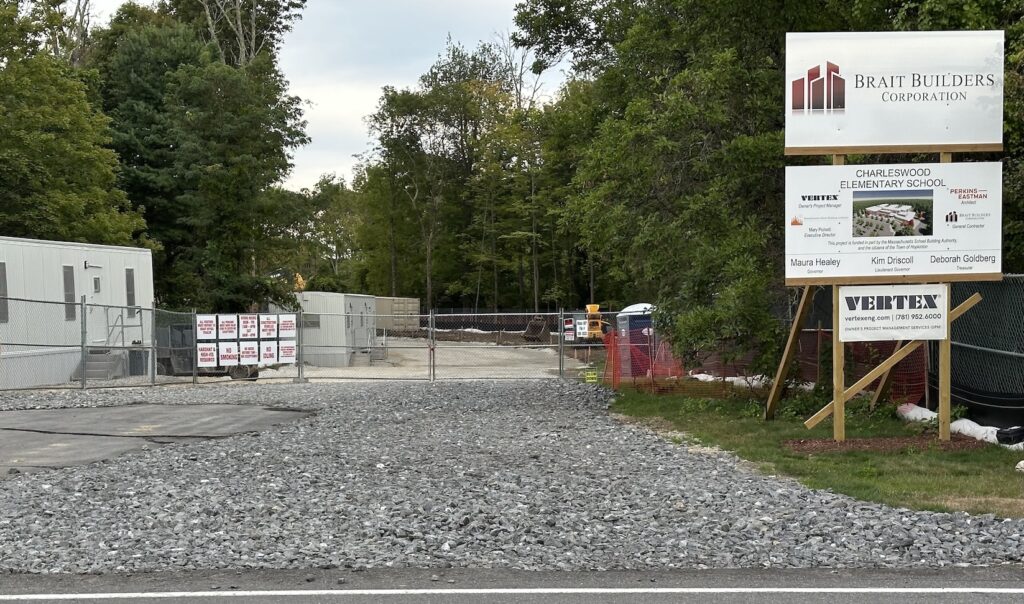
He requested a 1.0 custodial position through the Buildings and Grounds/Facilities budget. Brauninger said the additional custodian would support the needs at Elmwood for the upcoming year as well as when the new Charleswood School opens during the 2027-28 school year.
Masters asked if the custodial position could be delayed a year.
“If we can save that money, then save that money,” Masters said.
Superintendent Evan Bishop said there are not enough custodians currently for a building of that size, and the position would be a “good transition” into Charleswood, which has even more square footage.
Susan Rothermich, assistant superintendent of finance and operations, spoke about trying to get standards up across the district. Although additions were put on buildings, no changes were made to custodial staff, she said.
The current staff cleaning 40,000 square feet is at a level that is “not acceptable,” Rothermich said.
Hopkins School
Principal Matt Cotter described a budget of $5.5 million, an increase of 4.9% over FY 26. The school has an enrollment of 669 students and a projected total of 677 at the start of the next school year, he noted.
Class sizes in Grades 4 and 5, each with 15 sections, are expected to average 22.7 and 22.4 students, respectively.
In general education, there are no requests for additional personnel. Hopkins is seeking to add a 1.0 FTE intensive special education teacher position through the special education budget account.
The general supply account decreased by 5.6% ($4,185). There is a request for three musical instruments (French horn, half-size string bass, three-quarter-size cello) to expand the inventory and meet the program’s needs as it transitions to a Grade 5-6 school, Cotter said.
Hopkinton Middle School
Principal Matt Lefebvre talked about a proposed budget with a 6.1% increase ($480,514) not including new personnel requests. Contractual obligations for salaries total $477,559.
New personnel requests, at a cost of $154,050, are for a 1.0 FTE reading interventionist and a 1.0 position in related arts.
He said based on STAR and MCAS testing data, the interventionist would assist students who are struggling with reading but not on individualized education program (IEP) plans.
Lefebvre estimated 6-10 students would fall into this category per grade level, and the interventionist also would help the teacher with instruction for all students.
The principal noted reading skills are pertinent across all subjects, including social studies and science.
He anticipates the new related arts position would be in the visual arts, which includes photography, digital art and graphics. He said the position would bring down class sizes from 30 to around 27, which also corresponds with the number of available computers in classrooms.
Masters asked if there would be metrics to determine if the money was well spent.
Lefebvre replied that the district keeps track of student growth over the years for that purpose using testing scores and other assessment data.
Athletic Department
Athletic director Ricky Andrade said his proposed budget increased by 3.1% ($38,976), mostly because of contracted services.
Requests include two stipends for the gymnastics program. Andrade noted that the varsity and assistant varsity gymnastics stipends were approved at the Oct. 9 School Committee meeting.
He said the athletic coaches’ line is offset by $450,000 from the athletic revolving account.
There is an increase in contracted services of $25,889, which Andrade said is because of increased costs for ice time, pool rental, transportation and official fees. The supplies and equipment account does not have an increase, Andrade said.
Technology, Learning & Innovation
The technology budget reflects an increase of 4.1% ($128,086.42) over the FY 26 budget, according to Bishop.
He said it funds three key areas: maintaining core operating systems and infrastructure, building staff needs in data services and technical support, and supporting essential software and hardware renewal cycles necessary for teaching, learning and operations.
Although there are no requests for new personnel, Bishop said future growth necessitates rebuilding instructional capacity by using technology integration coaches. The roles would help teachers effectively use new technologies like AI and data analytics.
He said growth in the Data Services Department is important for the integration of new databases, software and data analytics platforms.
Finally, key expenses are driven by the district’s equipment refresh schedule, including new Chromebook leases for Hopkins and Elmwood and classroom items such as LCD projectors and document cameras, Bishop said.












0 Comments