

The Commission on Disability met with members of the Hopkinton Police Department on Monday to learn more about how its traffic team handles accessible parking enforcement and ways residents and police can work together to ensure handicapped parking remains available.
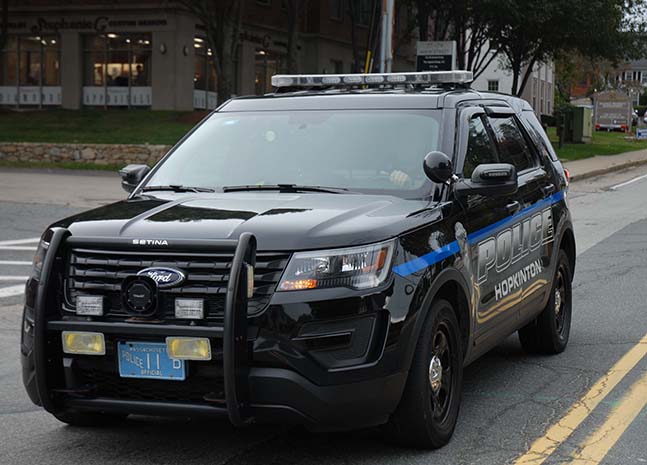
Sgt. Cody Normandin, who heads up the HPD’s traffic team, and Officer Justin Cappuccio provided an overview of both the applicable accessibility laws and how the department utilizes its discretion when handling parking complaints.
Cappuccio noted the HPD’s goal is “to ensure accessible parking spaces remain available for individuals who legally rely on them through education, voluntary compliance and fair enforcement.”
In his presentation, Cappuccio explained that Hopkinton Police look for valid and current disability plates and placards on any vehicle parked in an accessible space. Officers also make sure that placards are being used by the persons to whom they were issued. They check that a vehicle is parked properly within a space and are keeping striped access aisles clear as well.
Cappuccio stated that HPD officers focus on compliance and will adjust how they respond to a parking complaint based on relevant factors. “We have discretion in these situations, just like everything in policing,” he said.
“We try to make contact with a person instead of just jumping straight to a ticket and tow,” he added.
According to Cappuccio, officers often will attempt to educate drivers first. However, the HPD keeps logs of repeat offenders and will adjust their response accordingly. Enforcement actions available to officers include confiscating placards, ordering a vehicle be towed, submitting reports to the Registry of Motor Vehicles and documenting violations.
Cappuccio also assured commission members that officers are trained to focus on the violations. “It’s not our job now — it never will be — to determine someone’s disability,” he said.
Normandin added to Cappuccio’s presentation, noting that Hopkinton Police average between five and six accessible parking violations a year. “It’s about 50/50 on whether officers were able to find the person [in those cases],” he explained. “The other half were intentional things officers did issue a citation for.”
Enforcement issues discussed
Commission chair Nancy “Punky” Drawe thanked the officers for their presentation and asked about sending pictures of parking violations. She said she recognized that the department is relatively small, and given parking complaints are not emergencies, she wondered whether sending a photo to the HPD would be appropriate.
“We’d rather you call,” replied Normandin. He explained that the HPD’s dispatchers handle all incoming emergency calls and complaints and it is “more streamlined for us to have the complaint over the phone.”
Interim Police Chief Scott van Raalten, who joined the meeting toward the end of Cappuccio’s presentation, backed up Normandin’s request. “If you see something, call us, please,” he said. “We want to address it.”
Added van Raalten: “Any descriptive information you can give about the vehicle … will go a long way.”
The officers also recommended those reporting parking violations to call the department’s business line rather than 911.
Van Raalten said that one of the primary issues with enforcement is that officers can’t always get to an area where a complaint is before the vehicle leaves. While accessible parking is one of the few violations police can enforce on private property, often patrons of certain businesses where these violations occur are gone before an officer can respond.
The interim chief added that the department could consider engaging in some targeted enforcement actions.
McWhite clarifies occupancy rules
The commission engaged in a discussion about handicapped parking availability and other accessibility features of areas of town. The conversation arose from comments Drawe and member Nancy Cavanaugh made about parking at 1 Lumber Street.
Members noted that businesses in the mall such as The Spoon do not have curb cuts in front of them. Likewise, Cavanaugh stated that accessible parking availability near 110 Grill becomes limited. “There’s a lot of handicapped spots, but it does seem like some [cars] I have seen without properly displayed placards,” she said.
Member Pamela Loch claimed that the proprietors of a physical therapy business in the strip had reached out to the building owner “a number of times” about the curb issues and an ongoing concern with not being able to pull a door open.
“He just hasn’t been receptive, at this point, to doing anything,” said Loch.
Drawe asked Christopher McWhite, the town’s ADA coordinator, whether there were ways of having the businesses or building owners address the commission’s concerns.
McWhite clarified that any changes done to a building need to be done at the time of occupancy. He also provided insight on the minimum requirements for accessible parking spaces.
Commission plans Select Board visit
In other business, the commission outlined its topics of discussion for an upcoming meeting with the Select Board. It has a tentative meeting with the board on Oct. 20.
Projects the commission plans to highlight in its presentation include a handrail for the front walkway ramp at the Hopkinton Public Library, which recently was installed.
“That’s something we are proud of and everyone should know [about],” said Drawe.
It also will highlight its work with the Department of Public Works on an ADA self-evaluation and transition plan for town facilities, inclusion of McWhite into the commission, coordination with the HPD on accessibility concerns and attendance at national disability conventions.
Loch also recommended the commission develop a mission statement as it plans to move forward to its next projects. “That will cover a lot,” she said.
















0 Comments