

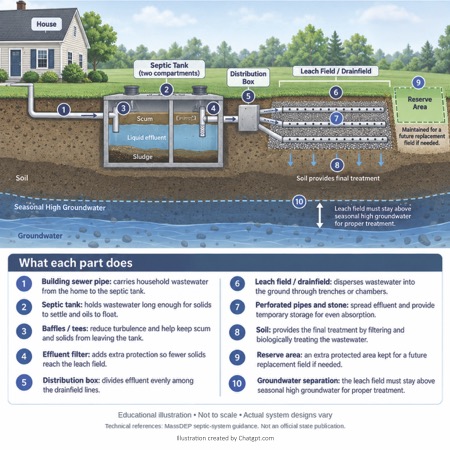
In Massachusetts, a conventional septic system is an option when the lot has suitable soils, setbacks and enough room. Title 5 is the state code regulating on-site septic systems, rather than a single system type. A typical gravity-fed layout includes a building sewer pipe, septic tank, distribution box and soil absorption system, also called a leach field or drain field. [1] Wastewater leaves the home and enters the septic tank, where heavy solids settle to the bottom as sludge and oils float to the top as scum. Baffles or tees help keep those solids in the tank. The partially clarified liquid, called effluent, then flows to a distribution box, which spreads it among the leach field lines. [1, 2]
In the stone-and-pipe layout shown, perforated pipes disperse effluent through stone-filled trenches. Other approved designs may use chambers. As effluent moves into the surrounding soil, natural filtration and biological processes provide additional treatment. The leach field must be properly separated from seasonal high groundwater. Some sites require pumps or alternative treatment systems; the appropriate design depends on the property and applicable requirements. [1–3]
Educational overview only. The accompanying illustration is not to scale or a construction plan; actual system designs vary.
Sources: Massachusetts Department of Environmental Protection
1. Septic Systems/Title 5 Glossary
2. Caring for Your Septic System
3. Innovative Technology and Title 5 Systems
Kim Foemmel
Foem mel Fine Homes
1 Lumber Street, Suite 207C
Hopkinton, MA
(508) 808-1149
Kim.Foemmel@gmail.com
FoemmelFineHomes.com
The advertiser is solely responsible for the content of this column, which is a paid advertisement.






0 Comments