

Good morning, Hopkinton! Welcome to the daily update we call Hopkinton Today — a quick recap of yesterday’s news, highlights of what’s on tap, and a photo of the day.
SGC hopes to meet with CIG to discuss herbicide questions
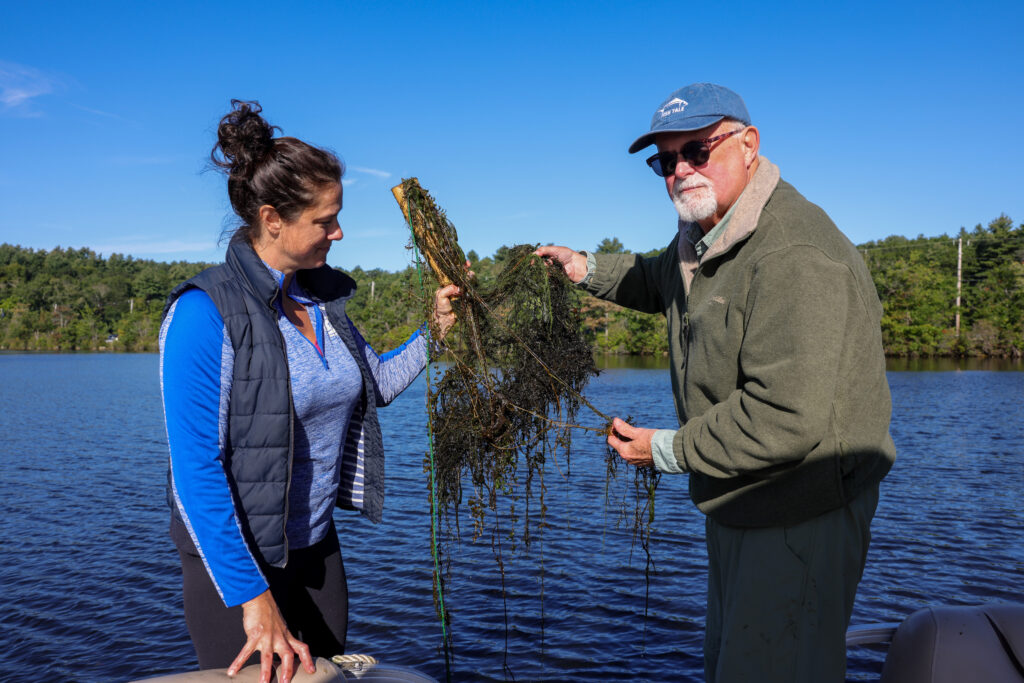
Lake Maspenock Preservation Association vice president Sabine St. Pierre (left) and limnologist Dave Mitchell show some weeds they removed from the water during a past analysis. FILE PHOTO/JOHN CARDILLO
The Sustainable Green Committee is looking to engage the Citizens Input Group of the Lake Maspenock Weed Management Group about its advocacy for herbicides in the lake.
The SGC last week reviewed a number of questions regarding recommended herbicides by the Citizens Input Group (CIG), the process for selecting which chemicals would be used and efforts to evaluate herbicide use risks. It planned to submit them to the group and evaluate the responses.
“Once the CIG has had time to review, we’ll hold a joint meeting to discuss the issue in depth and decide on any next steps,” SGC chair Geoff Rowland explained in an email to the Independent. He anticipates the process will be collaborative.
The town applied two herbicides in the northern basin of Lake Maspenock last summer. Tribune (diquat) and Aquathol-K (endothall) were used to target variable milfoil and pondweed, two invasive weed species.
At a CIG meeting in October, Lake Maspenock Preservation Association president Sabine St. Pierre stated the herbicides had worked to curtail weed growth. CIG chair Joe Baldiga noted, however, that the weeds had “come back with a vengeance.”
The group advocated for an extended drawdown of the lake this winter and a planned application of herbicides in the spring during a Select Board meeting in December.
Opponents of a chemical solution to invasive weeds have expressed fears over creating a “toxic treadmill.” They argue that decomposing plant matter killed by the chemicals would fuel future explosions of weed growth, resulting in more aggressive herbicide treatments. As well, opponents argue the targeted treatments impact other wildlife and the long-term health of the lake’s ecosystem.
“Broad chemical application across our landscapes has been shown to contribute to steep declines in insect populations, which in turn affects birds, fish and other wildlife that depend on those insects,” stated Rowland. “Since ripple effects like these can alter the entire ecosystem, we feel it’s important to consider the full range of options and potential consequences.”
Added Rowland: “Because these chemicals are designed to kill living organisms, the SGC believes we should approach their use with caution.”
— NICK SCHOFIELD
Latest News
Local political leaders recently reflected on the actions of immigration officials across the nation and how ICE action in Hopkinton could be addressed.
Hopkinton High School girls hockey co-op coach Chuck Costello said the team is starting to jell and build confidence under new coaching.
The latest Real Estate Transactions list shows just three homes sold in the past week.
This week’s Library Corner features information on schedule updates, a painting class for older children and a “KPop Demon Hunters” party.
Cheryl Soucy, 77, of Hopkinton passed away Feb. 5. She was a devoted volunteer for Project Just Because and the Hopkinton Senior Center.
James Kurzontkowski, 80, passed away on Feb. 2. He grew up in Hopkinton and attended Hopkinton High School.
Barbara Smith, 89, passed away peacefully on Feb. 1, surrounded by loved ones after a long battle with illness. She graduated from Hopkinton High School.
Town meetings tonight include the Commissioners of Trust Funds (5), Parks & Recreation Commission (6), Tax Relief Committee (6), Conservation Commission (7) and Marathon Fund Committee (7).
Photo of the Day
As part of the Hopkinton Basketball Association’s Night at the Celtics, youngsters from Hopkinton greet Celtics star Jaylen Brown as he walks onto the TD Garden court for the second half of this past Friday night’s game against the Miami Heat.

PHOTO/JERRY SPAR




















I would ask those advocating for herbicide control of the lake weeks why they believe the weeds “came back with a vengeance” as quoted in the article and why given that, we as a town should continue paying the cost on the order of $50,000 a year. The “treadmill” of treatment has been warned about since the lake herbicide use was first considered. Now we have the first proof of that here in town. This means we’re also actually paying to make things worse, ensuring the treadmill of paying for treatments will continue far into the future. Yes herbicides are convenient to use and provide sporadic relief, but are costly, encourage more growth, and introduce toxins harmful to people and wildlife. Alternatives exist that are less convenient than herbicides but would not introduce toxins and could be more effective. It’s not a simple problem with a simple solution because it involves a complex web of interacting elements. I encourage the town to look into the impacts of the herbicides as well as alternatives upon the ecological system over the long term and the ongoing costs in making the decision on how to proceed.
The HOPKINTON INDEPENDENT Feb.10 article “SGC Looks to Collaborate Regarding Herbicide Use” fails to clarify “opponents of chemical solution” and the Sustainable Green Committee are one and the same. The SGC opposes the unsustainable, ecologically harmful use of toxic chemical herbicides in Lake Maspenock as fiscally and environmentally irresponsible. The SGC urges the Select Board to reject the $55,000 requested expanded use of several hundred gallons of toxic herbicides to be administered by DPW in Lake Maspenock in 2026 as fiscally and environmentally irresponsible. This chemical request by CIG feeds a herbicide treadmill which doesn’t manage aquatic plant life in the long term. The science and studies on the use of toxic chemical herbicides clearly show plants are only mitigated in the short term and will return. Federal and state government environmental agencies also warn nutrients released from killed plants cause more future plant growth, toxic algal blooms, and more applications of herbicides (a herbicide treadmill). And as noted, these chemicals designed to kill life, harm non targeted life forms supporting the ecosystem of the lake. The SGC supports a non-toxic, holistic plan incorporating limiting watershed nutrient loading, barrier plants, benthic barriers, draw down, hand pulling, and mechanical plant management as detailed in the Lake Maspenock Aquatic Vegetation Control & Watershed Management Plan June 2021.
Donald Sutherland, Chair, the Environmental Working Group, SGC