

The Select Board on Tuesday approved adoption of a draft zero-emission vehicle first policy in a 2-1 vote but questioned funding sources.
Julia Chun, the town’s sustainability, economic development and equity project manager, gave a presentation with two members of the Sustainable Green Committee. She noted that Hopkinton is designated as a “green community in good standing.” But adoption of the zero-emission vehicle (ZEV) policy would elevate the town’s standing to a “climate leaders designation.”
She added that this plan has the support of the police, fire, public works and facilities departments.
The ZEV designation would make the town eligible for state grants, Chun said. The largest one she mentioned would be a $1.15 million grant for renewable energy applications and programming. Others would help fund heat pumps, solar energy and battery storage.
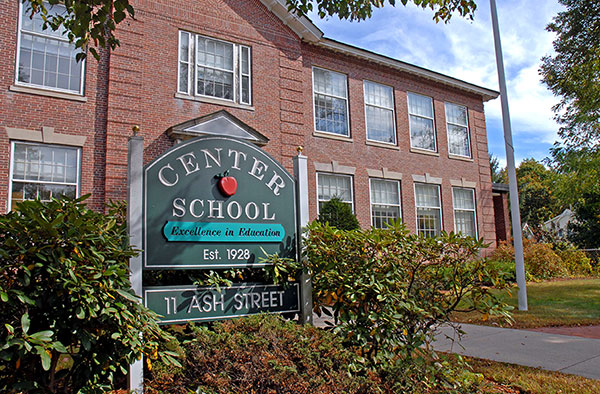
She added that state funding, if received, could be used to upgrade the HVAC systems at the schools and the Senior Center and toward the Center School reuse project.
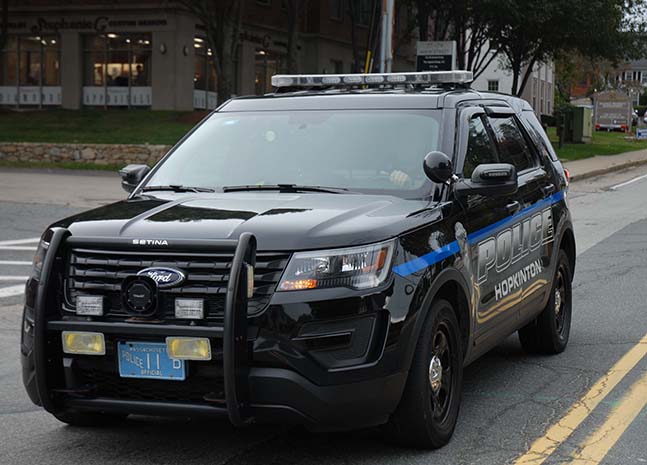
Department vehicle maintenance and fuel costs would go down if departments switched to electric vehicles or hybrids, Chun said. She gave an example for the Police Department. If it switched to electric Chevrolet Blazer LT SUVs from the current Ford Explorers, the annual maintenance cost is estimated to be $1,596 lower annually per vehicle. Maintenance savings could be $946 per year.
“You’re not doing things like expensive engine operations,” Chun explained.
If the entire fleet of town vehicles were switched to EVs, the average annual savings would be $500,000. Maintaining the fleet now costs an estimated $1.6 million.
The upfront investment would be $12 million, according to Chun. Savings by 2050 was estimated at $1.1 million.
Chun stressed that because of town financial constraints, a move to plug-in hybrids or hybrid vehicles would be an improvement over the current vehicles.
Select Board member Amy Ritterbusch said she supported the policy that moved the town toward sustainability.
Chair Joe Clark said he previously had an issue with the proposed policy because he did not believe the emergency vehicles could last for long periods of time on electricity. He acknowledged the support of the police and fire departments of the new draft.
Geoff Rowland, the Sustainable Green Committee chair, explained that “there are exceptions for vehicles with emergency responsibilities,” meaning they would not be expected to rely on electricity all the time.
Member Matt Kizner said he was not supportive of this policy now. He questioned the future of state funding given a previous meeting when state Senate president Karen Spilka and Rep. James Arena-DeRosa painted a bleak picture with future state funding cuts amid slashed federal funding.
“I support this policy, but it feels really complex,” he stressed. “And it doesn’t feel fully baked.”
He added that it “begins a series of hopeful and aspirational revolving doors.”
Clark said nothing needs to be implemented right away.
Brian Herr recused himself from the discussion because of his work in the solar industry. Vice chair Shahidul Mannan was absent.















0 Comments