

Both the design engineer and contractor have ownership regarding the infiltration system at the Charleswood School site, according to a third-party geotechnical engineer from Haley and Aldrich.
The third-party engineer was brought in after conflicting explanations were offered by Samiotes Consultants and Brait Builders as to why the soil was not infiltrating on a portion of the site.
The matter was discussed at the last Elementary School Building Committee (ESBC) meeting and again Tuesday, when Chris Eberly of Vertex (the owner’s project manager) presented an update.
At the previous meeting, Eberly said Vertex and architect Perkins Eastman expressed concern when Brait Builders stockpiled with tree clearing and boulders in an area meant to be protected as designated in construction documents and the logistics plan.
After the materials were moved, they were replaced with a sediment basin, Eberly noted.
He said a repeat infiltrometer test showed that area was unable to pass any water in four locations. In a protected area, the retest results were almost the same as when tests were done as part of the initial permitting process.
Perkins Eastman, through Samiotes, issued a non-conformance notice to Brait.
Brait contended the design assumptions were not appropriate and said disclaimers in the original testing stated the soil was heterogenous and couldn’t be relied upon to produce the same results in different locations, Eberly relayed.
Both parties said they would abide by whatever the third-party engineer determined.
“To a certain degree, while the contractor had contributing factors to the problem,” Eberly explained, the assumptions made during design could not be proven by a single test.
“The resolution of that was not a clean ‘one side or the other,’ was responsible,” Eberly said.
Vertex requested both parties come to a joint conclusion on how to move forward and work toward a resolution.
Prior to last month’s meeting, ESBC chair Jon Graziano gave the go-ahead to allocate $15,000 for the Haley & Aldrich review. The total cost with markup is $16,500.
Eberly said if the soil was not infiltrating because of the contractor’s actions, Brait would be back-charged full costs and for the second round of tests.
However, on Tuesday night, he noted no one came back with change proposals or additional costs on that work. Therefore, Eberly said, at this point it would not be “advantageous” to back-charge unless additional costs are brought forward at a later time.
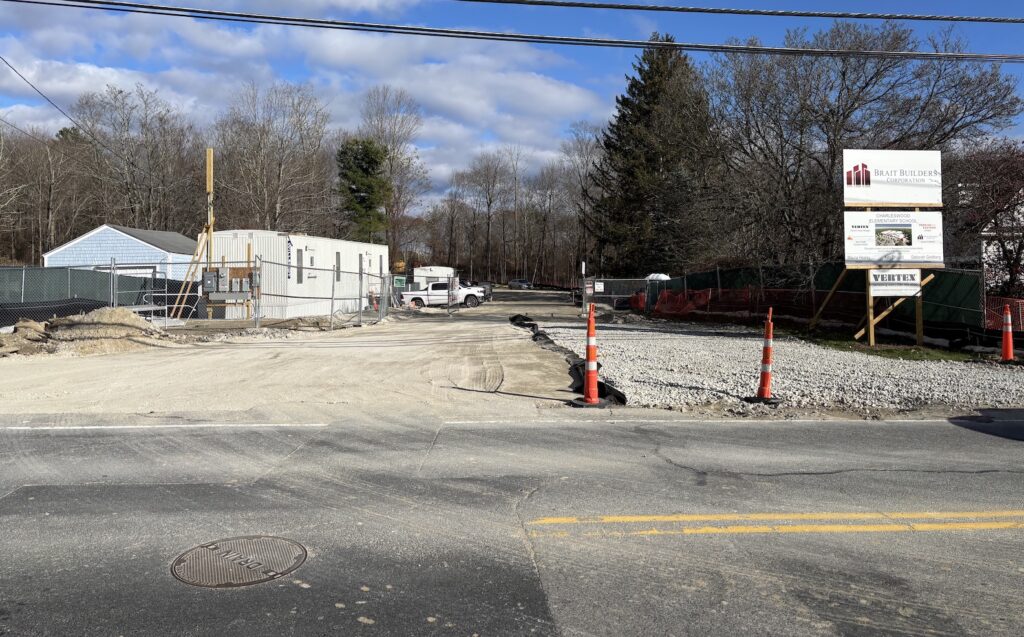
Roadwork on Hayden Rowe Street begins
ESBC chair Jon Graziano noted now that roadwork has begun on Hayden Rowe Street, “we’re starting to understand implications in reality.”
He said issues that had not been contemplated included having to remove a tree from a property because it was blocking power lines and preventing poles from being moved.
Graziano praised the Vertex team for its diligence in communicating with neighbors of the construction site, including sending weekly emails outlining the scheduled work. He said the owner’s project manager also actively manages challenges so that residents can get in and out of driveways, for example.
“We understand this is a disruptive time in your neighborhood,” Graziano noted, “and we want to do our best to minimize as best as we can — so any solutions we can come up with we’re happy to.”
He urged abutters to continue to reach out with questions and concerns.
ESBC member Bill Flannery added his appreciation to Graziano and member Mike Shepard, who are the board’s points of contact with neighbors. He said they have spent numerous hours and “done the heavy lifting” throughout the process.
Construction progress highlighted
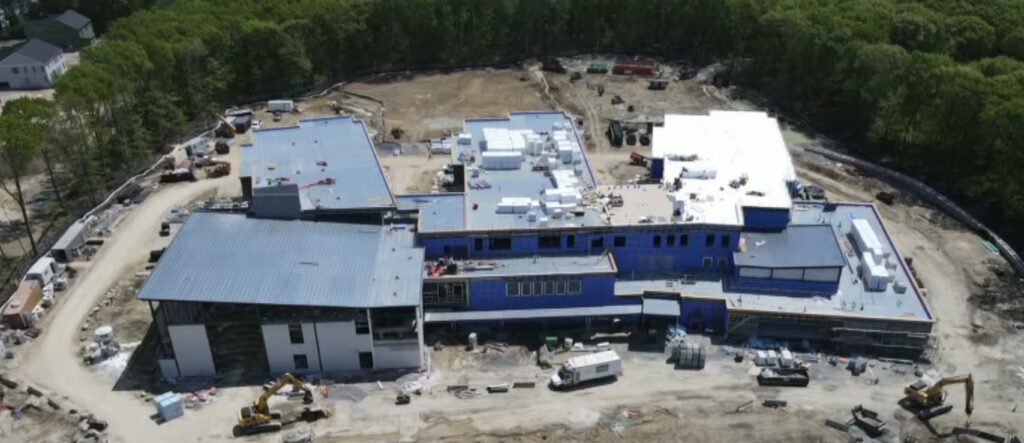
In other business, Vertex project manager Chris Kenney described photographs depicting recent construction at Charleswood.
He called the last concrete on slab placement in the gymnasium “another milestone accomplished” and showed images of partition framing, entry road curbing, an electrical duct bank extension, masonry wall and veneer installations, windows, classroom wallboards and more.
Kenney noted that dynamic window testing was done by blowing water and high-pressure air to test for leaks. None were found.















0 Comments