

Annual Town Meeting convened at Hopkinton Middle School on a soggy Saturday morning to vote on several key items, including passing the town’s operational and capital budgets for the upcoming fiscal year.
In roughly 4½ hours, members also approved major town policy changes. ATM amended the town’s MBTA zoning plan to meet state guidelines and approved a new 10-mph speed limit for e-bikes and other electronic mobility devices on shared-use paths.
This was the first time ATM was held on a Saturday since last year’s vote to shift it from a Monday night start to encourage more participation.
The meeting started at about 9:15 a.m. when a quorum of 131 members was reached. Most articles were approved in simple majority voice votes, but six of the eight votes tallied had less than that number. A quorum call was not made until after the first of three motions on Article 38 — the last article under consideration — was voted down. At that point, ATM was dissolved with a 58-8 vote.
At the meeting’s start, Town Moderator Zachary Kosan sped up the process by allowing a vote on several routine articles in a consent agenda. They included Articles 2, 4, 5, 7, 8, 9, 10, 11, 19 and 39. This vote passed by a two-thirds majority.
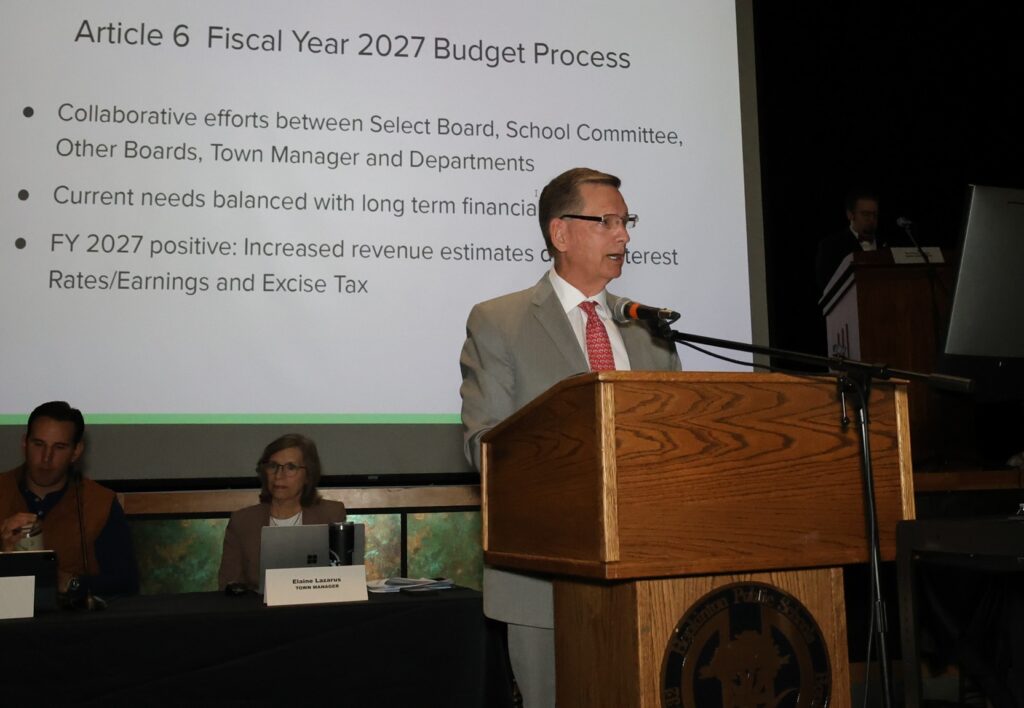
Bill Flannery from the Appropriation Committee discusses the budget at Saturday’s Annual Town Meeting. PHOTO/JOHN CARDILLO
Budget articles pass after discussion
Article 6, which outlined the town’s operating budget of $138,486,663, passed after some questions by a two-thirds majority vote. This was a 9% increase over the previous year’s operating budget.
For residents, the 6.06% increase will amount to about $851 more on a current $14,040 tax bill on an average home valued at $995,790.
Kyla LaPierre, the town’s chief financial officer, explained that the impact on the tax levy is 2.3%. This is less than the annual increase amount outlined in the state’s Proposition 2½, which meant that no operational overrides were needed. Town departments had been encouraged throughout the process to keep their budgets tight and maintain level service funding.
“Everything else in considered debt exclusion,” she said.
Capital improvement projects were approved separately in Articles 13-18.
LaPierre explained that escalating health insurance premiums remain a concern. This year, they rose by 18%.
MBTA Communities amended overlay district approved
One of the most critical articles to pass was Article 21, which amended the MBTA Communities overlay district in order to meet state guidelines. It passed by a two-thirds majority voice vote.
If the town did not pass an MBTA zoning plan that met state guidelines by May 31, it would have been deemed ineligible for some state funding, noted Planning Board chair Rob Benson. He stressed that the plan “only affects zoning” and does not require that multifamily housing units be built.
This is the third time Town Meeting has tackled this issue. At the May 2024 ATM, members rejected adoption of the MBTA Communities Act zoning bylaw by eight votes, with 118 in favor and 126 opposed. That November, a contentious Special Town Meeting was held mainly to vote on a new plan. It passed in a 236-167 vote. The inclusion of The Preserve, Walcott Valley and the downtown area in this overlay district brought its size to 54.6 acres with a unit capacity of 782, exceeding the state’s mandate in those areas.
The state determined that this plan only partially complied with this state mandate for multifamily housing units. It failed to meet the 50% contiguous area district requirement. To rectify this, a strip of eight parcels on Walcott Street was added to the last plan to connect the downtown zone with the Walcott Valley area to form a larger district.
“What we’re trying to do here is amend the map to comply with state law,” explained Benson. He noted that this has been a “long journey.”
Questions arose about whether the plan met the spirit of the state law, which is to create more housing units in communities served by the MBTA.
Said Benson: “Our job is to meet the requirements of the law.”
Geoff Rowland, chair of the Sustainable Green Committee, expressed support for the new plan. He described it as “closing the gap” on the former plan. Rowland also said that approving the plan would allow the town to avoid a costly lawsuit with the state.
10-mph speed limit for e-bikes approved
After robust debate, Article 28 passed in a 93-34 vote. It approved creation of a new bylaw for a 10-mph speed limit on shared-use paths for e-bikes and other electric mobility vehicles.
Discussion on the article revolved around safety and sustainability versus enforcement and practicality.
Proponents, including members of the Trails Committee and the Sustainable Green Committee, argued that the speed limit would be a guideline to encourage safety on trails.
“We do have a safety issue on trails with people driving e-bikes too fast,” stressed Linda Chuss, the Trails Committee clerk. “While this might not be a perfect solution to it, it will help with signage and education and will move us in a good direction to allow this great new technology, but to use it safely.”
She added that the Trails Committee is advocating for the speed limit on the stone dust trails to start. They currently include the Center, Hughes and Echo trails.
Resident Darlene Hayes brought up the issue of enforcement. She questioned “how much of a burden this is on our police.”
Trails Committee member Ken Parker stressed that a speed limit would provide a tool to get riders, particularly younger ones, to slow down.
Rowland said the Sustainable Green Committee unanimously supported the speed limit adoption. He stressed that “it’s about equitably supporting all forms of mobility” and would help reduce the amount of cars on town roads and their carbon emissions.
He added that there is no state law regarding speed limits of this type.
Resident Lya Batlle-Rafferty said the speed limit troubled her. Others agreed.
“A quick Google search shows that normal bikes tend to go 12-14 mph,” she pointed out.
Select Board member Amy Ritterbusch replied that this speed limit only would apply to shared-use paths, not roads. This bylaw would “begin the process” that would lead to enforcement.
Resident Steve Popkins supported the speed limit because he said it would increase pedestrian safety.
Resident John Ritz pointed out that the article mentions e-bikes and electric mobility vehicles. If the speed limit also applies to bicycles, he questioned why they were not included in the wording of the bylaw.
















0 Comments