

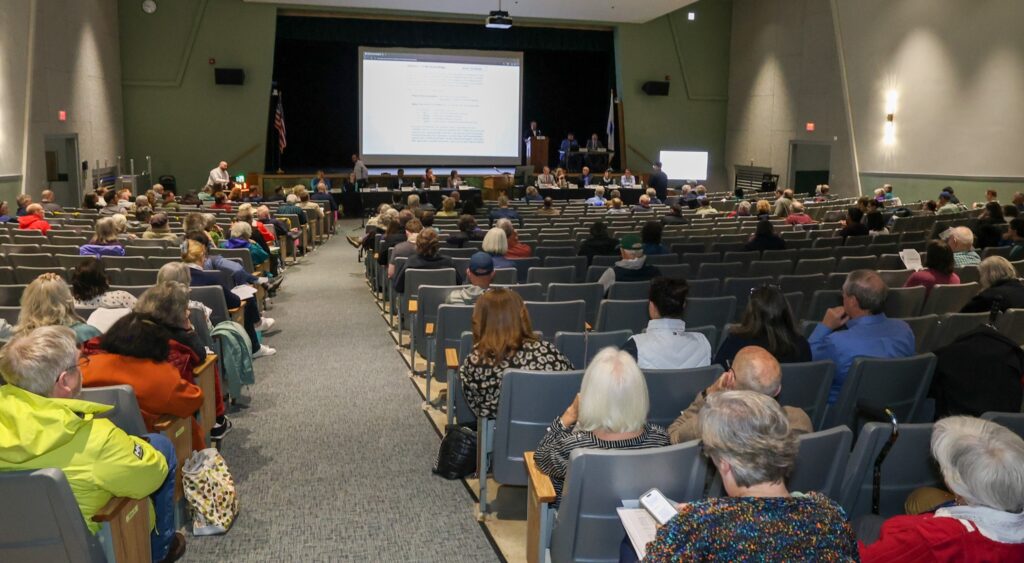
The Water & Sewer Advisory Board on Wednesday discussed several talking points that members expect will come up at Annual Town Meeting on May 2, including water quality concerns. Members will appear before the Select Board on May 5 to provide information on key water issues in town, particularly water conservation.
Chair Paul Gallagher noted that the town is at a Level 1 (mild) drought status. The state’s Executive Office of Energy and Environmental Affairs downgraded Hopkinton’s status on April 9. One month earlier, the town’s drought status was at Level 3, which is critical.
Gallagher said he will stress that WSAB advises the Select Board. It does not exist to give a “seal of approval” to projects.
Manganese levels above advisory level
At the Feb. 18 WSAB meeting, Kerry Reed, the Department of Public Works director, explained that elevated levels of manganese were detected in Wells 7 and 8. Located off Alprilla Farm Road, they commonly are referred to as the Alprilla Farm wells.
Manganese occurs naturally in drinking water because it is a common component of rocks, soil and groundwater. The elevated manganese levels were considered to be above the state’s advisory level of 0.3 parts per liter.
“It’s certainly a known in this area,” said Rob Scott. “It’s not just in Hopkinton. I don’t think this to be something that’s a concern to public health.”
He added that more iron and manganese are being detected because the town is pulling water from further out in the aquifer due to high water demand.
Assistant Town Manager Lance DelPriore confirmed that the Massachusetts Department of Environmental Protection steps in once these levels in drinking water and septic systems get “over a certain scale.”
“We’re not necessarily in a position where we can abandon Well 7 and Well 8,” Gallagher said, noting they don’t produce more than “100 gallons per minute combined.”
Brown water sometimes mistaken for PFAS
Over the past few weeks, residents have been cautioned by the Water Department to flush their pipes when they experience brown water. Scott noted that sometimes people “assume that brown water equates to PFAS.”
A group of per- and polyfluoroalkyl substances known as PFAS has been an issue in town for several years. High levels of PFAS led to a water filtration system being installed in Well 6, the town’s main well, and activated in 2024.
“I think the town has a problem with brown water,” said Gallagher. “And it’s not all due to iron and manganese in the groundwater.”
“There’s a misconception with brown water and pipes,” DelPriore pointed out. “[People] think it’s the pipe itself that’s rusting. What happens is there’s just a buildup of iron and manganese sludge in the pipes.”
Hydrant flushing helps to resolve this problem, he said, as well as filtration.
Scott added that he hoped the Water Department could be “more proactive” in the future with a “more vigorous flushing program.”
The limited quantity of water has “kind of held that back,” DelPriore said.
ATM articles impact water issues
Members discussed several warrant articles that apply to the town’s water resources.
Articles 15 and 16 request that members approve appropriation for water and sewer capital projects, respectively. Proposed by the Department of Public Works, the main water projects include the rehabilitation of Well 1, the construction of the Grove Street water tank and the East Street water main construction project. The major projects in Article 16 include upgrading the Westborough connection and the Fruit Street wastewater treatment facility.
Passage of the Well 1 project “would be a huge shot in the arm,” according to Scott.
The town is seeking approval to purchase the Carbone’s property, located at 280 Cedar Street, for $2 million. It plans to construct a water supply pump station for the potential connection to the Massachusetts Water Resources Authority system. The Community Preservation Committee is recommending purchasing a portion of the Carbone’s land for $225,000 for use as open space.
“Each of these articles needs to pass,” stressed Donald Sutherland. “Or else we’re dead in the water.”
Water conservation key issue
Gallagher stressed the importance of water conservation. He noted that the town is encouraging residents to minimize overall water use and follow local water restrictions. Hopkinton’s mandatory water supply conservation restrictions remain in place, banning nonessential outdoor water use.
Permitted uses during the water restriction include for food, fiber and livestock production, hand watering of gardens and “water use essential to the core function of a commercial business,” according to the town’s website.
Scott said the policy “has no teeth in it” because the fines are basically unenforceable.
“Nobody’s saying they’re happy with the water restrictions,” added Gallagher. He noted that he foresees continuing dependence on Ashland as a water resource for Hopkinton.
Said Scott: “It’s just sad that people that don’t follow the restrictions are ruining it for the rest of [the residents].”
















0 Comments