

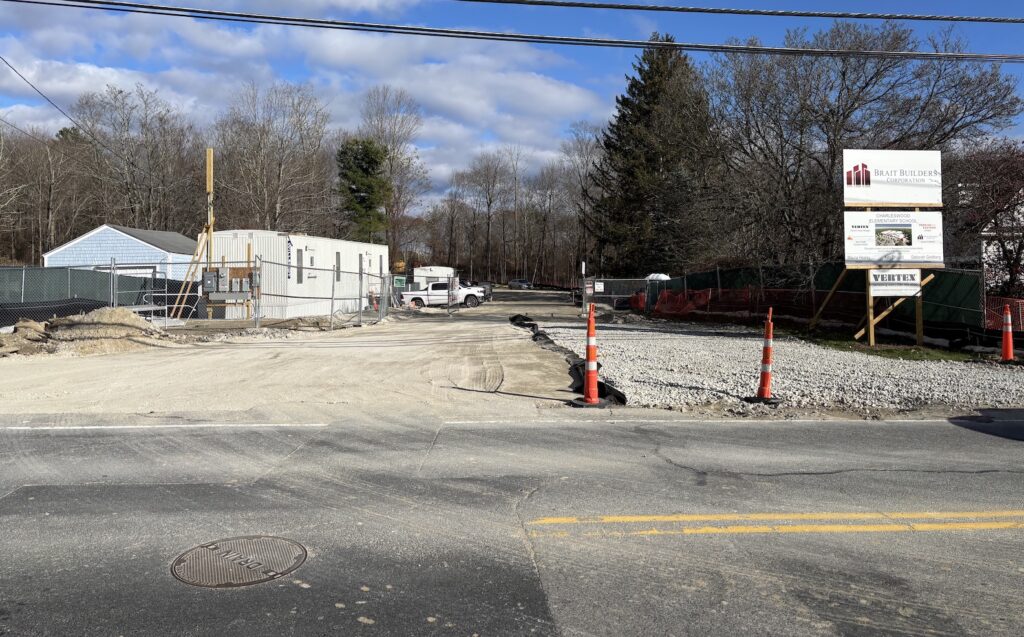
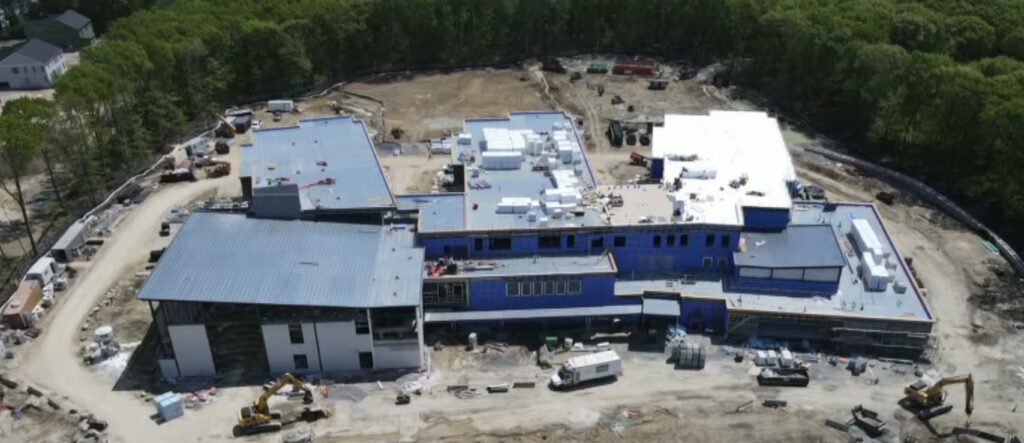
Vertex representatives said they are developing a “workable solution” to address the issue of water from the Charleswood School property running off onto a property co-owned by the Conservation Commission and town.
The Elementary School Building Committee on Tuesday heard a review and update about the situation prior to chair Jon Graziano and Vertex project manager Chris Eberly attending a Conservation Commission meeting later that evening.
Vertex project manager Chris Kenney said that an approved permit with the Planning Board and Conservation Commission included a stormwater discharge pipe on the conservation parcel.
He said Brait Builders ran into a problem and was unable to keep up with the required dewatering discharge and “got overwhelmed” with three geothermal rigs drilling wells.
Some of the “turbid” water was discharged off-site. A correction was made by adding a second discharge point further north that goes east and modifies discharge to the south, Kenney said.
He said the team is working on a redesign to remove a 6-inch diameter discharge pipe and developing a restoration plan for a small area cleared of trees and vegetation.
Kenney said the pipe and riprap that extended off the school parcel was “deemed to be non-permissible.”
Per town counsel, any structure on a conservation parcel must go through an Article 97 process, which often requires a vote of the Legislature and can be lengthy, Eberly said.
Rather than go that route, Eberly said, the design team would create a plan keeping off the conservation parcel and then “let the process play out.”
Eberly said there has been confusion because initially, the proposal included dry wells at the edge of the site. Through the permitting process with the Planning Board, an “offshoot” was created that led to the discharge area. He said that the Conservation Commission had included the narrow strip where the dewatering was occurring in its order of conditions.
Nonetheless, Eberly said, “there is no reason to move forward with this [Article 97] approach if we have an easily adjustable alternative.”
He added, “The discussion with ConCom about what makes up a restoration plan and what should be permitted is ongoing with no conclusions yet.”
Graziano thanked the Vertex team for its work on this issue, adding, “There’s definitely been opaque moments about what is going on and what our responsibilities are.”
Project receives Passive House certification
In what Kenney described as “great news,” he said architect Perkins Eastman received word that the design certification for PHIUS (Passive House Institute US) was granted to the Charleswood project.
With the certification for energy efficiency, Charleswood becomes the largest school to date to be design certified in this way. He said following this “major milestone,” it is now up to the contractor team to follow through with its construction requirement.
From the committee’s perspective, Graziano said, it is “what we promised to the town when we proposed this project.”
He said the certification is a significant step toward “delivering the most efficient school we can and to drive the best educational outcomes for our students.”
“We’re excited by how much of a sustainable school this is going to be,” Graziano said.
Financial information presented
In his budget update, Kenney reported that Perkins Eastman’s contract value to date is $9,211,755 (or 75.4% of the total), Vertex is at $2,158,862 (43.6%) and Brait Builders’ billings total $35,690,227 (34.7%), which he said was consistent with where the contractor is in the construction process.
He noted commitments to date total approximately $122 million and expenditures to date total $47.8 million.














0 Comments