

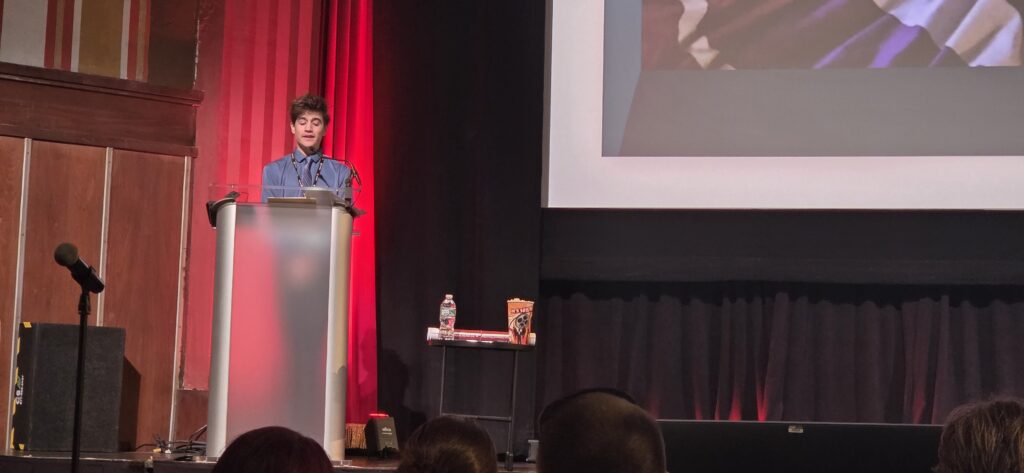
Eli Marshall recently spoke at Harvard Medical School’s Pediatric Mind-Body Symposium about functional neurologic disorder. He was designated as a faculty member at that time. PHOTO/TINA MARSHALL
Last May, Eli Marshall, then 12 years old, experienced one of the most exciting — and frightening — times in his life. As he prepared for a Memorial Day weekend baseball tournament, he began to experience sudden, uncontrollable twitches.
“This time last year, things started getting weird,” he said in a recent interview with the Independent that included his mother, Tina Marshall. “It wasn’t like a sports injury where I felt a pop or a snap.”
This May, Eli spoke at Harvard Medical School’s Pediatric Mind-Body Symposium about his eventual diagnosis of functional neurologic disorder (FND). Now virtually symptom free, he has been designated as a faculty member at age 13.
From tourney prep to FND diagnosis
“If you asked me a year ago who I was, I probably would have just said a kid who likes video games, card collecting and playing tennis,” Eli said. “Baseball is one of my passions, and I’ve played it for most of my life.”
As a catcher, Eli said he feels a sense of control. He can see the entire field and direct plays.
But as the tournament approached, he felt increasingly helpless. He contracted pneumonia. His respiratory system had been impacted by two nasal reconstructive surgeries after a facial accident in 2022. At this time, the twitches escalated to “large whole-body jerks that I couldn’t explain.”
The twitching lasted almost constantly, only ceasing during sleep. Eli became physically and mentally exhausted.
“For me, as a catcher, this was a big problem,” he said. “I couldn’t be in charge of the field when my body was doing things I wasn’t telling it to do.”
Eli said his pediatrician was unable to explain his symptoms.
“It’s a really strange feeling when the experts tell you nothing is wrong even though they can see and feel your own body acting up in front of you,” he recalled.
Later, he was seen in the emergency room at Boston Children’s Hospital. There he was diagnosed with FND.
“The only thing Eli asked was, ‘Am I going to be able to play in my baseball tournament?’ ” his mother shared. “We had just enough time to drive home, grab his bag and head straight to the field.”
FND is caused by changes in how brain networks work, rather than changes in the structure of the brain itself, according to the National Institute of Neurological Disorders and Stroke website. Its cause is unknown. Symptoms include seizure-like episodes, cognitive impairment, movement and speech difficulties, distraction and fatigue.
Said Tina: “Basically he was sent home with, ‘This is your diagnosis. We don’t know how to treat you. But here are two websites that you can go to and do your own research.’ ”
Search for treatment
This diagnosis fueled Tina’s quest for answers. Persistent advocacy led to a caring doctor and occupational therapist within three weeks of Eli’s diagnosis.
“I spent three days straight on the phone calling every doctor, resource center and research study group that was listed on these two websites,” she explained. “But they were typically for adults.”
Added Tina: “I knew that doing nothing was not an option for us.”
She learned from one occupational therapist that FND “became a very prominent condition during COVID.”
“A lot of people spent a very large amount of time on the internet,” she explained. “Coupled with anxiety, their bodies started to mimic a lot of the material that they were watching online or in video games.”
During a virtual consultation, the occupational therapist referred the Marshalls to Dr. Matthew Goldfinger, a clinician investigator at Massachusetts General Hospital and instructor in neurology at Harvard Medical School.
“He was able to really identify that this was FND,” said Tina. “It’s something that you have to retrain your brain to fix. The sooner you minimize the symptoms, the more likely a patient is to be completely relieved of their symptoms in the future.”
“He described it like a computer,” added Eli, noting it was a two-hour doctor’s visit. “Nothing was wrong with the hardware. It was like I had software with a bug in it.”
Goldfinger gave Eli some home exercises as well as occupational therapy. Eli also was referred to a neurologist at Boston Children’s Hospital.
Eli and Tina shared several coping strategies. They include speech therapy, chiropractic treatment, progressive muscle relaxation exercises, daily massages, using weighted blankets, exercises with weights, vagus nerve stimulation and nutritional adjustments.
Some of these techniques were recommended by fellow parents of FND patients. She also retooled her questions to facilities that would only treat people over age 16, asking what they recommend for their patients.
“I’ve gotten to the point where they’re more of an as-needed thing,” said Eli.
When Eli feels like he may experience tics, he sucks on sour candy. This distracts his brain and stops the anxiety response.
“The most amazing thing my occupational therapist said to do was to have at least 30 minutes each day where I can just do something super fun,” he said.
Eli’s sense of humor has helped him manage this condition, mother and son agreed.
“My friends and I made a joke of it,” he said. “My parents and I played a game called ‘beat the tic.’ ”
Eli’s teachers are aware of his condition. In case of triggers, he has an “FND recovery bag” in each classroom. It contains sour candy, flash cards with distraction exercises and instructions on symptom management.
Added Eli: “While some of these strategies may seem a bit unconventional, they all have one common theme — self-care.”
Speech leads to faculty position
At the Harvard Medical School Pediatric Mind-Body Symposium, Eli gave a 15-minute presentation. He integrated his speech with videos of his tic and seizure episodes.
This event led to his designation as a faculty member. He has been invited to next year’s conference to speak on his FND diagnosis and recovery,
“I stuck with most of these practices, mostly because my mom nagged me,” he joked in his speech. “My mom is way more stubborn than a doctor. And that’s why I got my treatment.”
Eli’s persistence likewise paid off. He said he has been symptom free since September 2025.
“If you look at me today, things actually seem pretty back to normal,” he said. “But even on the normal days, it still feels like it’s there. It’s like having an app running in the background of your phone that you can’t quite close.”
Eli also shared this advice for medical professionals.
“Please listen to your patients or their family describe their struggles and healthcare concerns,” he implored. “Listen with intent, listen with purpose and listen with heart.”
















I commend their tenacity in looking for doctors, diagnosis and how to deal with this condition. In today’s world of complex conditions, shortage of doctors, and difficult insurance companies we all have to be very involved in advocating services and medical help for our loved ones.
I was diagnosed with FND 6 yrs ago I would love to talk to you about I do have alot of info My Neurologist at MGH is Dr David Perez he specializes in FND . KNOWLEDGE IS POWER.TRUE INFO IS VERY IMPORTANT. I LIVE IN BOSTON’S NORTH END FOR 47 YRS.I was born in Malden Ma at 2 yrs old my mom became a widow one month before I was born at 2 my mom,sister and me moved to Hopedale were my Step father was from.As of right now there is NO CURE.EEG’S ,CAT SCANS AND MRI’S DO NOT SHOW ANY SIDES THERE IS ANYTHING WRONG. A COUPLE OF ANALYGYS IS THE BRAIN GOES THROU A LUP ON FAST DRIVE WHICH MISSES THE NERVIOUS SYSTEM SO THE NERVIOUS SYSTEM MISSES THE SIGNAL FROM THE BRAIN WHICH THEN CAUSES THE BREAK DOWN JOIN FND HOPE.ORG AND WAVES.PLEASE FEEL FREE TO REACH OUT TO ME ANY TIME
I’d ve more than happy to share our knowledge of doctors, therapies and strategies to help you or anyone else. Reach out any time
I agree: doctors, listen to your patient. If I had a dollar for every patient that’s heard “there’s nothing wrong with you”. Be honest & say ” I know this isn’t normal & something is wrong but I don’t have the answer.”