

The Parks & Recreation Commission on Tuesday revised and approved a draft policy that will open up the Fruit Street pickleball courts to fundraising groups starting this year.
Parks & Rec Director Jon Lewitus teed up the discussion by recapping previous discussions the commission has had over groups wanting to use the pickleball courts to fundraise. During those discussions, commission members stressed their desire for a formal policy — for at least the short-term — that would control the frequency, cost and approval process for allowing fundraisers.
The commission previously discussed the issue in March, when a group of Hopkinton High School students requested use of the courts to raise funds as part of a senior capstone project. The request was approved by Parks & Rec with the understanding that a formal application and use policy was forthcoming.
Lewitus told the commission that three user groups already have reached out to him about fundraising at the courts. He predicted that once the policy was in place, there would be more groups expressing their interest.
Under the policy, eight dates across the pickleball season will be designated as eligible for fundraisers. Lewitus noted that the commission had discussed “staggering alternating Saturdays and Sundays once per month.” While the courts would open up this year for user groups, Lewitus anticipated marketing the dates for 2027 as early as January.
Other provisions of the draft policy included an application period; the Parks & Rec Department’s rights to reassign, modify or cancel reservations; cost and a tiered priority structure for approvals.
“I think the language is good,” said vice chair Kyle Smith. “All the power resides with Parks & Rec, which I like.”
“We needed to start somewhere, and this is a really good start,” commented chair Dan Terry.
Commission members made adjustments to some of the provisions in the policy, debating how long the application window needs to be before the available date. “I think there has to be something, because I don’t want people reaching out to me Thursday before Saturday.”
The initial period outlined in the draft was 30 days, but commissioners agreed to shorten it to 15 days.
The commission also cleared up the details of the tier system and how fees would be applied. Lewitus shared that the most expensive tier would include for-profit businesses and non-resident groups.
In discussing the fee structure, commissioners agreed that user groups who want to run a tournament would have to rent out all eight courts. For all tiers except the most expensive, groups would be charged $25 per hour per court for a total rate of $200 per hour for the whole facility. For-profit businesses and non-resident groups would be charged $50 per hour per court.
Lewitus floated the idea of offering a fee waiver for certain groups. “Do we want to charge for a Hopkinton High School group [that’s] maybe going to only fundraise X amount of dollars?” he asked.
Terry appeared open to the idea but expressed worry over limiting access to other users when fundraising amounts are low. “If they can’t raise that money, then it’s really not fair to block this out from potential users from town,” he said.
Other changes made to the draft policy included breaking fundraising days into two five-hour blocks to set limits on facility use.
“You can’t have all the courts for a whole day,” said Smith. “Real tournaments run for 10 hours. … You can’t do that.”
Pickleball lighting tabled for now
Lewitus offered commissioners a review of the results of Annual Town Meeting as they applied to Parks & Rec. Items approved for Parks & Rec at the meeting included the department’s fiscal year 2027 budget, Community Preservation funding for benches and a capital request for the Sandy Beach perimeter fence. However, funding for proposed lights at the Fruit Street pickleball courts was rejected.
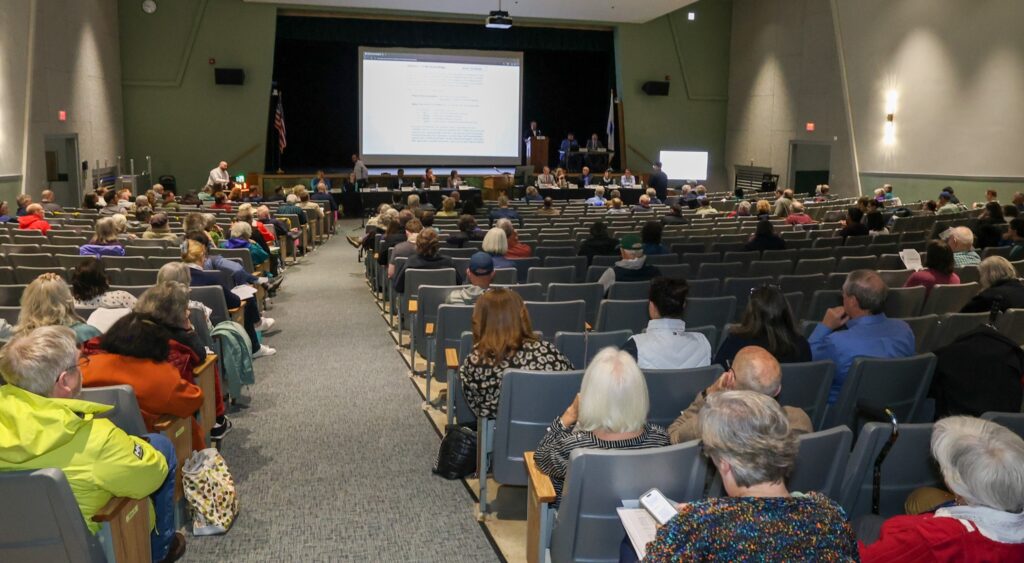
Voters at Annual Town Meeting on May 2 pulled the lighting request out to be considered separately from the rest of the Community Preservation Committee’s funding requests. Due to concerns over light pollution and impacts on both abutters and local wildlife, the request was defeated 85-81 with a two-thirds majority required.
“I didn’t think there would be much pushback, and I don’t think there was adequate support of people that would be interested in the project,” Terry said.
Lewitus agreed that more community support at Annual Town Meeting would be needed if Parks & Rec decided to pursue the item again.
Commission members discussed ways of getting invested parties to show up to vote for the project, as well as better communicate how the lights actually work.
“They’re thinking of it, I think, more in terms of the football field where you have broad lighting,” member Lynn Taylor said. She added that if it had been demonstrated how the LED lights would not contribute light pollution to the area, “they wouldn’t have been so adverse to this.”
Terry shared that he would be interested in trying again only if there was a show of support and changes were made in both the presentation and how Parks & Rec is asking for the funds. He expressed wariness over just bringing back the same line item to the next Annual Town Meeting.
“It would make me crazy if [a request] came back with a new font next year, and the following year, and we had to talk about it again over and over,” he said.

















0 Comments