

Private ways and the town’s policy for accepting them as public roads were the main focus of the Planning Board’s three-hour meeting Monday night.
The first private road discussed was Morse Lane, which was approved as a private road in 1992. It is part of the Capobianco subdivision, according to principal planner Aneri Patel.
Patel said the town does not have “any official records” about the road because it is private. On the approved plan, there was a condition that the roadway be 18 feet wide. It should have a 1.5-foot gravel base and be covered with reconstituted asphalt.
A developer reached out to the Planning Board in 2022, seeking to amend the 1992 decision to allow for five lots rather than four. At that time, the Planning Board added a condition prohibiting upgrades to Morse Lane until a definitive plan was presented to the board showing upgrades.
Several residents of Spring Lane and Morse Lane attended the meeting. They traded accusations about the removal of trees and the widening of Morse Lane. Patel said her office received complaints about these two issues.
Colin Scanlon said he represented Morse Lane residents. He explained that residents have been performing maintenance on the road. They also removed “lots of rotten trees that were ready to fall down.”
He denied widening the road and encroaching on abutters’ properties.
Patel advised the proponent to apply for an amendment to the 2022 condition.
Chair Matthew Wronka said the issue facing the board is to determine whether the street is in compliance with the 1992 and 2022 amended subdivision definitions. Wronka and Patel urged residents on both sides to submit documents from their respective surveyors.
The issue will be taken up at a future meeting once the surveyors’ documents are received.
Auciello Drive discussion tabled
Wronka asked the board to table the discussion regarding Auciello Drive becoming a private way. He favored taking a deeper dive into the policy regarding street acceptance by the town instead. The chair stressed that the discourse should not focus on particular streets.
He explained that the Select Board has the authority to accept private ways as public roads. But it seeks the Planning Board’s feedback first.
The policy that the Planning Board follows regarding subdivision standards was last updated in 2014 by the Select Board, added Wronka.
In most cases, he explained, a developer proposes a subdivision that includes roads that would be up to the town’s subdivision standards. Each road acceptance decision goes before the Select Board and ultimately to Town Meeting.
Some roads were meant to be private because they are unable to support traffic or “connect to anywhere,” Wronka said.
Wronka asked the board if it wanted to reinforce the current policy that new roads be subject to subdivision standards and benefit the town in order to gain public road acceptance.
Member Peter Mimmo asked if there was “any room for discretion” in case some private roads are what he called “almost up to snuff.”
“It’s going to be really hard to forecast all the potential possibilities, particularly with a private road and what its original intended use was,” said member Brian Johnson.
Wronka proposed that the Select Board be consulted as to what it is seeking in Planning Board recommendations.
Vice chair Lucia Lopez also noted the poor condition of some public roads. The decision to repair them comes down to “a funding and budgeting question,” she said. This is why the decision falls under the Select Board’s purview, she added. She said that there are “levels of disrepair” that should be considered.
Wronka said another factor would be how the road fits into the town layout for safe travel.
LNG facility hearing continued
The board voted 8-0 to continue a hearing on stormwater management and earth removal permits for 55 Wilson Street until July 6.
This 51.5-acre parcel is the site of three cryogenic storage tanks that are part of Eversource’s liquefied natural gas (LNG) facility.
Robert Sykes, a peer review consultant from Pare Corporation, noted that there were 17 comments regarding the LNG facility’s stormwater management plan. The major one questioned whether there were any “known reported releases of hazardous materials within the work limits.” If there were, Sykes asked for a plan about soil management. He also requested additional erosion controls.
Tim Grace of Tighe & Bond represented the applicant. He said the plans are being updated to incorporate Sykes’s feedback.
“These sites were developed over 50 years ago,” he added. “Back then they didn’t think about or care about stormwater management.”
Clinton Street requests approved
The board approved three motions pertaining to the development of a second home at the rear of a historic house at 82 Clinton Street.
Special permits were approved for the lot with a historic structure to be subdivided (7-1) and for a common driveway (6-2). A street frontage waiver was approved in a 7-1 vote. A supermajority vote was required because of the historical structure.
Member Anya Diwan opposed all motions. Member Rob Benson opposed the common driveway special permit.
The applicant, Aaron Stone, withdrew his application last month. This allowed all members of the newly constituted board to vote.
Previous meetings focused on the application of the bylaw regarding “lots with historic structures.”
“This is a project that I think is in harmony with the bylaw,” said Stone.
The Board of Appeals’ variance for insufficient frontage for the new home and the support of the Hopkinton Historical Commission influenced members to vote in favor of the project.
Preliminary design for Pyne Field presented
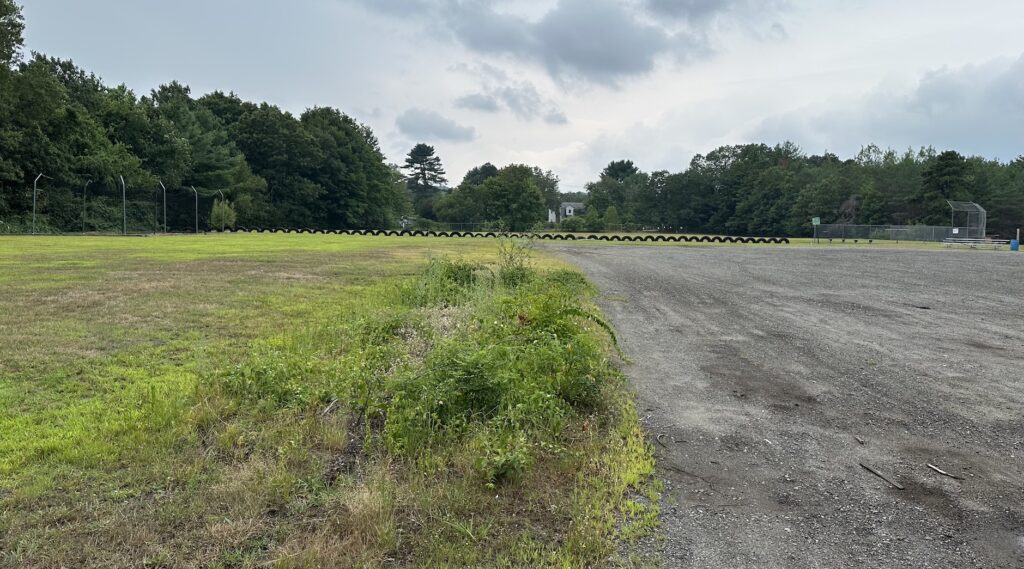
Parks & Recreation Director Jon Lewitus showed the Planning Board what he called “a rough plan” for a cricket pitch and a redesigned baseball field at Pyne Field.
At the May 28 Parks & Rec Commission meeting, Lewitus explained that Article 20A, approved at Annual Town Meeting on May 2, allowed the commission to consider alternate locations for the cricket pitch and baseball fields intended for Pyne Field. The article amended a previous funding request for $1 million approved by the Community Preservation Committee and Annual Town Meeting in 2023.
In this conceptual plan, the cricket pitch would be located where a joint parking lot previously was proposed. He noted that the preferable option would be to separate the two fields.
Improvements would be made to the baseball field, he added.
Parking would be located above and below the fields, giving each sport a separate area. This would prevent people from having to cross the access road, which was an issue with the previous design.
“I think this is a much better plan, and it will be better for the town,” said Benson.















0 Comments