

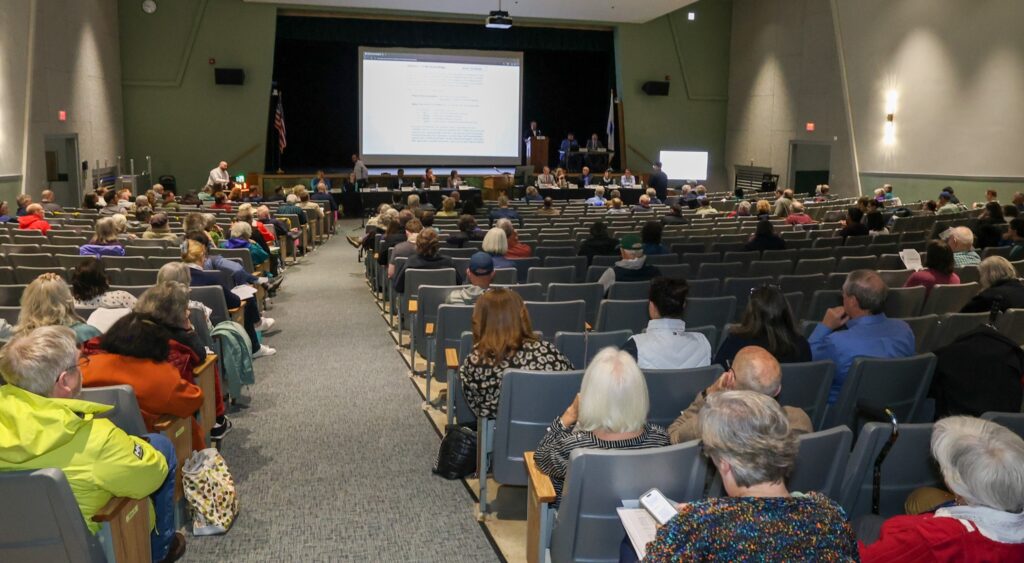
The Permanent Building Committee on Tuesday unanimously approved the revised schematic designs for the Center School reuse project. The changes will shave at least $1.2 million off the proposed $16.8 million price tag.
At the May 6 meeting, the committee asked architect Jeremy Toal from Gorman Richardson Lewis Architects (GRLA) to revise the plans to reduce costs.
When the Center School reuse project initially was proposed two years ago, the cost was estimated to be $10 million. The town formed a public-private partnership with the Hopkinton Center for the Arts. The town agreed to pay $6 million, while the HCA was expected to contribute $4 million.
The building’s ground floor would have a lobby and classroom space for the HCA. The first floor would house the Parks & Recreation Department and provide community meeting space. The Youth & Family Services Department would occupy the third floor, providing room for activities and meeting space.
Cuts to scale, smaller items lead to savings
Toal explained that the overall size of the addition to the original 1928 building was reduced by about 578 square feet. He aimed to keep the character of the original design while pairing down its scope.
The ground-floor lobby addition area was trimmed from 1,120 square feet to 884 square feet. During the last meeting, the lobby was deemed a key component to the building as the welcoming area for what is hoped to be an area attraction.
“So it’s a little more compact,” said Toal. “But it still has the same overall feel.”
Other changes to the ground floor included the elimination of a small laundry room. It was moved to a “nook” on the same floor. Also, a half-wall and gypsum ceiling treatment for a dance studio were cut.
This concept worked well with the upper floors, he noted. The two upper floors each were reduced from 793 square feet to 622. The canopy size also was lessened.
“On the upper floors, what we’ve mostly done is remove the framing for the conference rooms,” explained Toal.
Items including the framing, cabinetry and closets were removed to “simplify” the design, Toal said. The assumption was that they could be added to the project at a later date, pending funding.
The design kept a storage room on the upper floor for a roof ladder. But it cut the kitchenette, with the exception of the sink. Youth would need access to a sink for some of their creative activities.
Ceilings were modified on the upper floors. “Specialized details” were removed from the cloud ceilings, which now will be used mainly in the large assembly rooms and the public meeting room.
Another cost-cutting measure was repairing the slate roof of the 1928 building rather than replacing it. Toal estimated a savings of about $680,000.
Concerns about sacrifices raised
Dave Daltorio, the town’s engineer/facilities director, explained that the goal for the Parks & Rec and Youth & Family Services floors was “to improve things and to provide additional space for those departments, as well as other town events.”
He feared eliminating the cabinets and storage space would lead to having game boards and jackets “all over the place.”
“There are some savings in here,” said Daltorio. “But I just want to make sure we’re not going too far.”
Ken Weismantel, the Community Preservation Committee chair, said furniture and other items could be purchased later as needed.
“Is there anything we can do on the site that can be deferred?” questioned PBC chair Dan McIntyre. “I just want to make sure that we don’t cut so much out that Parks & Rec or Youth & Family Services has to come back next year [to Town Meeting] to say, install a closet or a sink or something else.”
He stressed: “Nobody wants to spend money on the Center School twice.”
Toal noted that reductions in contingencies could cut “another half-million or so” from the cost.
Also, the $16.8 million figure included the demolition work. A May 2 Annual Town Meeting vote approved $2.4 million in CPC funding for this project aspect, further slashing the number.
Toal said some of the cut items could be added in during the construction phase if money was available.
The next step is for GRLA to prepare contract documents for the demolition work to the two Center School additions. Toal noted that the hazmat investigation of the site will take 6-8 weeks.
He added that design development documents are in the works. A consultant will review them while the demolition work occurs.
Police station HVAC system design reviewed
The committee also learned about the proposed plan for a new HVAC system for the police station. It was designed to be implemented in two phases to save upfront costs.
Kristen Esposito, a mechanical engineer at IMEG, gave a presentation outlining the current and proposed systems.
“The current issues are that the equipment is nearing its end of life,” she explained, noting that it is about 23 years old.
The “biggest issue,” according to Esposito, is that some areas of the police station are not being heated or cooled properly. One example she noted is that the training room is always hot during the summer.
Multiple air handlers are being used by a single condensing unit, she explained. This condensing unit uses R-22, a refrigerant that is “no longer permitted for installation.”
Another issue is that freezing has occurred at the preheat coils for all the current system’s air handlers.
“Our goals for the project are to address the building issues and then also prioritize cost-efficient electrification,” said Esposito.
The first phase would include replacing all air handling units (AHUs) due to their age. New AHUs would have heat pump coils, a backup hot water coil and an energy recovery wheel. They also would have associated exhaust fans and filters.
“We’re still wanting to do a heat pump approach with a split system,” added IMEG engineer Jon Brenton, calling the plan “an optimization.”
The existing boiler system would be replaced with high-efficiency condensing boilers, Esposito said. There would be a new building management control system.
The project’s second phase would include installation of a 30-ton heat pump chiller. The chiller would be tied into the existing boiler loop. The boiler system would remain in place as an emergency backup.
By the time the second phase is completed, for $1 million, the building would be “fully electrified,” said Brenton.
Daltorio added that Eversource would need to be involved because he hadn’t anticipated an electrical service upgrade. Grant money may be available through the Mass Save program, he said.
This first phase is expected to cost $1.5 million, Daltorio said. Funding for this phase has been included in the town’s capital plan. Members leaned toward the two-phase approach.
















0 Comments